
NewVersion 1.2
Nuclear Binding, Fission & Fusion
Weigh a nucleus against its parts to find its binding energy, place any nuclide on the binding-energy curve, compose fission and fusion reactions, grow a chain reaction, and see how protons fuse in the Sun.
About this simulation
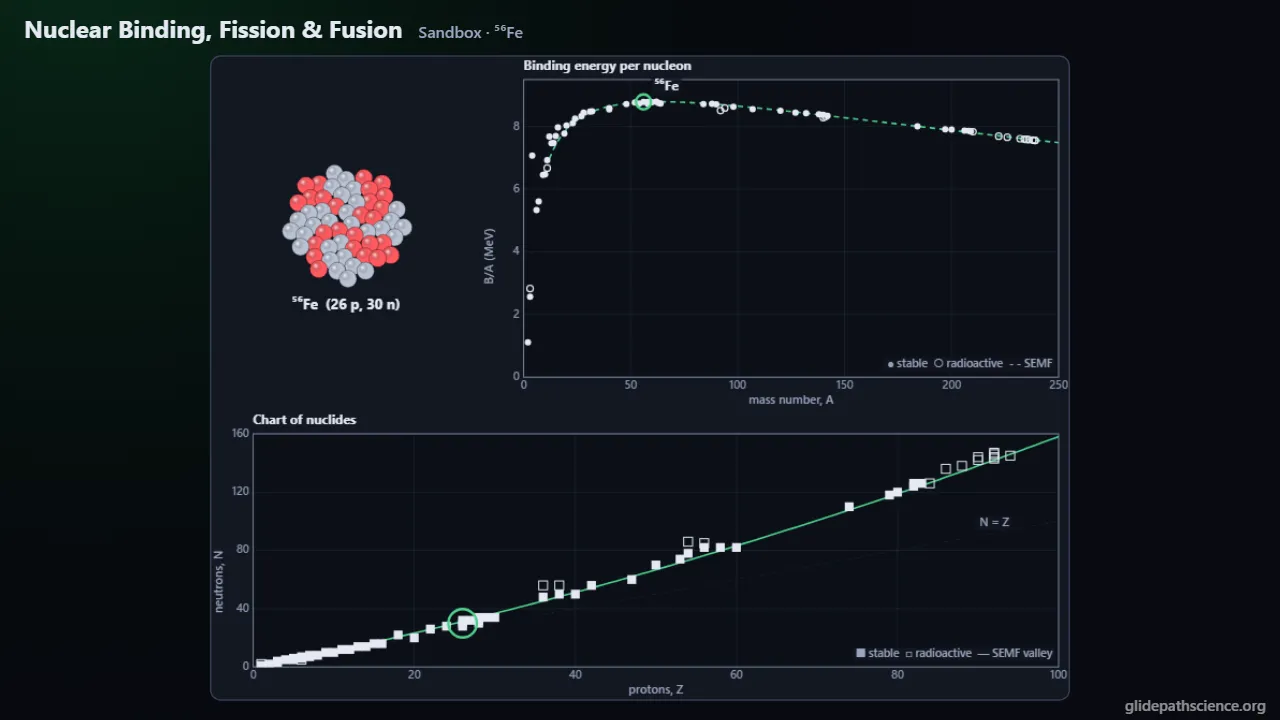
Why do heavy nuclei release energy by splitting and light ones by joining? Students weigh helium-4 against its protons and neutrons, turn the missing mass into binding energy with B = Δm c², and find that binding per nucleon peaks near iron and nickel. A guided walkthrough at two levels continues to one uranium fission, chain reactions, the proton–proton chain, why the Sun is hot and energy per kilogram; the Advanced track adds atomic masses, the liquid drop and the semi-empirical mass formula, the valley of stability, alpha Q values, the fission barrier, delayed neutrons, the Gamow peak and the CNO cycle. The Sandbox builds any nuclide a nucleon at a time, places it on the binding-energy curve and the chart of nuclides, and composes fission, fusion and decay reactions with their Q values. A Chain Reaction tab grows a chain generation by generation under a chosen k and, in Advanced, steps a reactor’s reactivity; the Stellar Core finds the Gamow peak where tunneling meets the Boltzmann tail. A concept challenge and a prediction lab round it out.
What you'll learn
- Explain why a nucleus weighs less than its separate protons and neutrons, and compute its binding energy from B = Δm c², with 1 u equivalent to 931.494 MeV.
- Use the binding energy per nucleon, which peaks near iron and nickel, to explain why heavy nuclei release energy by splitting and light ones by joining.
- Explain how the multiplication factor k decides whether a chain reaction dies, holds steady or grows, and why delayed neutrons make a reactor controllable.
- Explain why fusion needs heat and tunneling: nuclei must close against their Coulomb repulsion, and in the Sun only the fastest protons, tunneling through the barrier, fuse.
What you can do
- Guided walkthroughStep-by-step, in Intro and Advanced tracks.
- SandboxEvery control of the model, to explore freely.
- Concept checksQuestions about ideas and vocabulary, with no calculating.
- PredictionCommit to a prediction, then see the result.
- Classroom demoProjector mode and recordable clips for slides.
- Works offlineA single downloadable file, verified to run without a network.
Before you start
- Atoms, protons, neutrons and isotopes
- Mass–energy equivalence, E = mc², and the electron volt
- For the Advanced track: exponentials and logarithms, Coulomb’s law and the Boltzmann factor
Run or download
Run it in your browser
Nothing to install and no account. Works on laptops, Chromebooks, tablets, and phones.
Launch Nuclear Binding, Fission & FusionDownload for offline use
One HTML file (644 kB) that opens in any modern browser with no network: for rooms with unreliable Wi-Fi, or to keep a copy.
Download the fileFile details and checksum
- File
nuclear-binding-fission-fusion-v1.2.html- Version
- 1.2, released November 15, 2026
- Build
9cf6870- Size
- 659,867 bytes
- SHA-256
aecfd2453374291f0c1c06c90eafbd6d531f8a898c478665ed8e0914efdda354- Offline
- Checked to run with all network access blocked.
The model and its limits
What the model assumes
- Masses are atomic masses (electrons included) from the Atomic Mass Evaluation for 68 nuclides from hydrogen to plutonium; with hydrogen atoms in place of protons the electrons cancel, and β⁺ decay subtracts 2mₑ.
- Binding energy is B = [Zm(¹H) + Nmₙ − M]c², with c² = 931.494 MeV/u.
- The semi-empirical mass formula has five terms, four fit by least squares to the table’s nuclides with A ≥ 16 and the pairing coefficient held at 12.0 MeV; a nuclide off the table takes its numbers from it.
- Each fission frees 3 neutrons with probability 0.43 (else 2), and each neutron causes a fission with probability k/2.43, so each generation averages k times the last.
- Advanced reactor kinetics uses one group of delayed neutrons (β = 0.0065, λ = 0.08 s⁻¹), with the stable period from the one-group inhour equation.
What it leaves out
- No shell structure or magic numbers (the formula is a liquid drop), no excited states, and no decay rates or half-lives.
- The chain reaction is a teaching model, not a reactor calculation: no geometry, moderator, enrichment or critical mass, and k is set by hand.
- Fusion uses only the Gamow and Boltzmann factors with a point-charge barrier; the nuclear S-factor, screening and the weak interaction’s slowness are described, not computed, so no reaction rate is predicted.
- Fission barrier heights are quoted from published values, not computed from a deformation model.
Cite this simulation
APA 7
Meier, D. (2026). Nuclear Binding, Fission & Fusion (Version 1.2) [Computer simulation]. Glidepath Science. https://glidepathscience.org/simulations/nuclear-binding-fission-fusion/
MLA 9
Meier, David. Nuclear Binding, Fission & Fusion. Version 1.2, Glidepath Science, 2026, glidepathscience.org/simulations/nuclear-binding-fission-fusion/.
AIP
D. Meier, Nuclear Binding, Fission & Fusion, version 1.2 (Glidepath Science, 2026), https://glidepathscience.org/simulations/nuclear-binding-fission-fusion/.
BibTeX
@misc{meier2026nuclearbindingfissionfusion,
  author       = {Meier, David},
  title        = {{Nuclear Binding, Fission & Fusion}},
  year         = {2026},
  publisher    = {Glidepath Science},
  version      = {1.2},
  note         = {Interactive simulation, version 1.2},
  howpublished = {\url{https://glidepathscience.org/simulations/nuclear-binding-fission-fusion/}},
  url          = {https://glidepathscience.org/simulations/nuclear-binding-fission-fusion/}
}
Credits and license
Created by Dr. David Meier, Glidepath Science.
Based on: OpenStax, University Physics Volume 3, by Samuel J. Ling, Jeff Sanny and William Moebs: Chapter 10, Nuclear Physics (10.1 Properties of Nuclei, 10.2 Nuclear Binding Energy, 10.4 Nuclear Reactions, 10.5 Fission, 10.6 Nuclear Fusion), an open textbook licensed CC BY-NC-SA 4.0 (openstax.org). The Intro track follows its order of topics; the text, numbers, figures and simulations are this lab’s own. No endorsement by OpenStax or the authors is implied.
Licensed under Creative Commons Attribution-NonCommercial-ShareAlike 4.0 International (CC BY-NC-SA 4.0). You may share and adapt it for noncommercial purposes, such as teaching, with credit and under the same license. Licensing and reuse
AI tools (Claude, from Anthropic, and ChatGPT, from OpenAI) were used in developing Glidepath Science and its simulations. Dr. David Meier reviewed, edited, and modified every release version.