
NewVersion 1.5
Quantum Eraser Lab
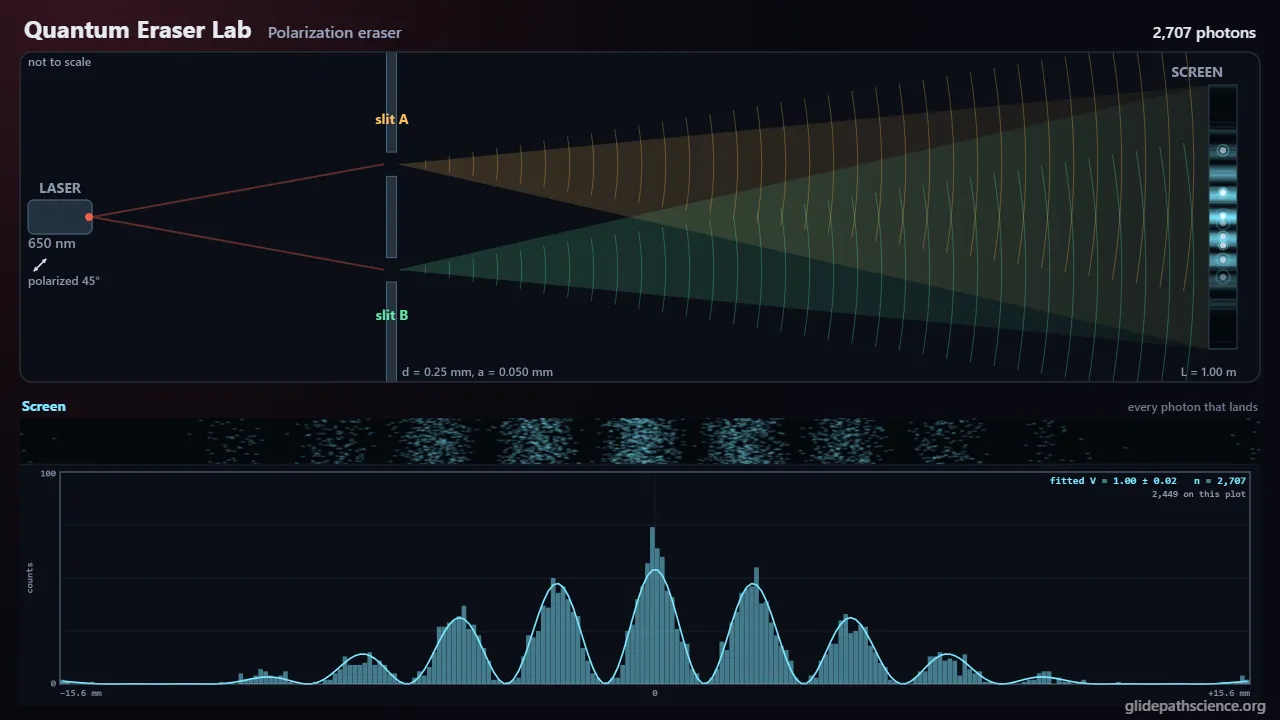
Tag the two paths through a double slit and the fringes vanish; erase the tag and they return, but only in a sorted or filtered subset of the photons, never in the whole pattern.
About this simulation
Photons build up a double-slit pattern one dot at a time, and polarization markers over the slits remove the fringes even though nothing ever reads them. A third polarizer, or a splitter, brings fringes back only in complementary subsets that add up to the smooth hump. With entangled pairs, as in the delayed-choice eraser of Kim et al., the choice to erase can come after a photon has landed, and the record at the screen still never changes: fringes appear only when the dots are sorted by their partners' records, which travel no faster than light.
What you'll learn
- Tags kill fringes: fringes need two paths that end in the same state, so orthogonal markers remove them even though nothing ever reads the markers.
- Visibility and distinguishability share one budget, V² + 𝒟² = 1, so markers 60° apart give fringes of visibility 0.5.
- Erasure sorts: an eraser does not restore the whole pattern but splits the photons into fringes and anti-fringes, which add back to the smooth hump.
- No message to the past: the signal photons' pattern never depends on what is done to their partners, or when, and seeing fringes needs the partner record, which arrives no faster than light.
What you can do
- Guided walkthroughStep-by-step, in Intro and Advanced tracks.
- SandboxEvery control of the model, to explore freely.
- Virtual labA realistic experiment with measurement noise and data analysis.
- Concept checksQuestions about ideas and vocabulary, with no calculating.
- PredictionCommit to a prediction, then see the result.
- Classroom demoProjector mode and recordable clips for slides.
- Works offlineA single downloadable file, verified to run without a network.
Before you start
- Two-slit interference and the fringe spacing λL/d
- Linear polarization and Malus's law
- Probability as the fraction of many trials
- For the advanced track: complex amplitudes and the Born rule
Run or download
Run it in your browser
Nothing to install and no account. Works on laptops, Chromebooks, tablets, and phones.
Launch Quantum Eraser LabDownload for offline use
One HTML file (786 kB) that opens in any modern browser with no network: for rooms with unreliable Wi-Fi, or to keep a copy.
Download the fileFile details and checksum
- File
quantum-eraser-lab-v1.5.html- Version
- 1.5, released November 15, 2026
- Build
3095646- Size
- 804,954 bytes
- SHA-256
42e75aec914da543e6a9dc12044baf337efc794c506426a5634c937bb4d75c8d- Offline
- Checked to run with all network access blocked.
The model and its limits
What the model assumes
- The polarization eraser uses real Jones vectors: polarizer film passes cos(α − θ) of the laser's amplitude along its axis, and a lossless marker is an ideal half-wave plate whose light leaves at the marker angle.
- Each output port's pattern is the single-slit envelope times (A + B cos δ), with δ = 2πdy/(λL), and the controls keep the screen in the far field, where this is within 3 % of the exact Fresnel pattern.
- The delayed-choice eraser follows Kim et al.: 702.2 nm pairs from a 351.1 nm pump, source regions about 0.3 mm wide and 0.7 mm apart, and an idler path 2.5 m longer than the signal's, with D0 in the focal plane of a lens taken as 1.00 m.
- Every detection is a Monte Carlo draw from the engine's distributions, so the histograms carry real counting noise, and fitted visibilities come with a standard error from that noise.
- Real detectors are modeled by efficiencies, dark counts, and a coincidence window, with accidental coincidences at 2τS₀S_k for steady, independent click streams.
What it leaves out
- Every photon is monochromatic and every pair perfectly correlated: the pairs' bandwidth, coherence length, and source size are left out.
- The D0 pattern uses one far-field envelope rather than Kim et al.'s two separate source regions, and their published fringes are roughly 0.6–0.7 mm apart rather than the model's 1.0 mm, which changes only the scale.
- Detector dead time, saturation, and timing jitter are not modeled, and the Coincidence Bench's time tags are exact.
- Optics are ideal apart from the detector settings: real polarizer film leaks and absorbs, splitters are not exactly 50/50, and only half-wave plates are modeled.
- With a laser, every pattern in the polarization eraser is also explained by classical polarization optics; the single-photon claims rest on single-photon or heralded sources, which the model represents by drawing one photon at a time.
Cite this simulation
APA 7
Meier, D. (2026). Quantum Eraser Lab (Version 1.5) [Computer simulation]. Glidepath Science. https://glidepathscience.org/simulations/quantum-eraser-lab/
MLA 9
Meier, David. Quantum Eraser Lab. Version 1.5, Glidepath Science, 2026, glidepathscience.org/simulations/quantum-eraser-lab/.
AIP
D. Meier, Quantum Eraser Lab, version 1.5 (Glidepath Science, 2026), https://glidepathscience.org/simulations/quantum-eraser-lab/.
BibTeX
@misc{meier2026quantumeraserlab,
  author       = {Meier, David},
  title        = {{Quantum Eraser Lab}},
  year         = {2026},
  publisher    = {Glidepath Science},
  version      = {1.5},
  note         = {Interactive simulation, version 1.5},
  howpublished = {\url{https://glidepathscience.org/simulations/quantum-eraser-lab/}},
  url          = {https://glidepathscience.org/simulations/quantum-eraser-lab/}
}
Credits and license
Created by Dr. David Meier, Glidepath Science.
Licensed under Creative Commons Attribution-NonCommercial-ShareAlike 4.0 International (CC BY-NC-SA 4.0). You may share and adapt it for noncommercial purposes, such as teaching, with credit and under the same license. Licensing and reuse
AI tools (Claude, from Anthropic, and ChatGPT, from OpenAI) were used in developing Glidepath Science and its simulations. Dr. David Meier reviewed, edited, and modified every release version.