
NewVersion 1.6
Circular Motion & Banked Turns
Every turn needs a net force toward the center. Whirl a puck, swing a cone, ride a vertical circle and a rotor, and find the window of safe speeds on flat and banked curves, all from the ground.
About this simulation
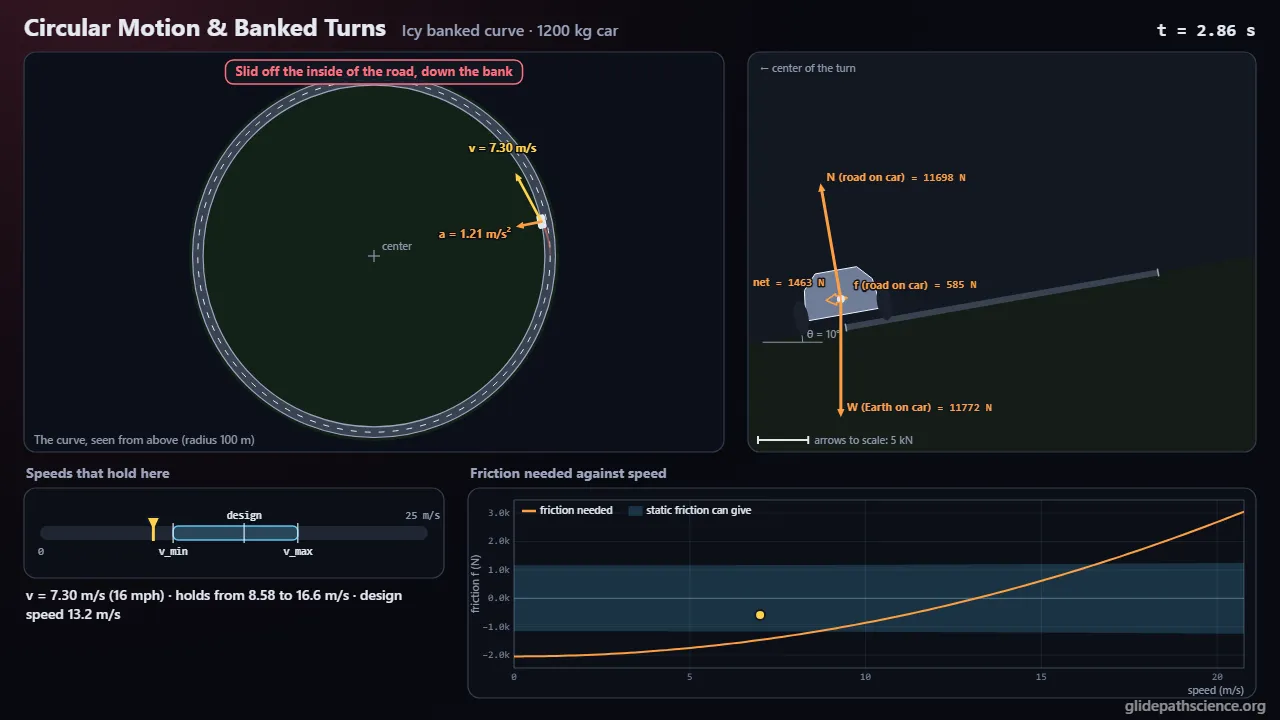
Circular motion seen from the ground, where a body moving on a circle accelerates toward the center and a real force with an agent has to supply mv²/r: a string, static friction, a banked road’s normal force, a wall, gravity or a wing’s lift. Five scenes run live with a force diagram drawn to scale: a puck on an air table (cut the string and it leaves along the tangent), a conical pendulum, a vertical circle on a string, rod, loop track, hill crest or Ferris wheel seat, a flat or banked curve with skids and rollover, and the rotor ride with its floor dropping away. A gauge shows the window that holds, and charts plot what the motion needs against what the support can give. A guided walkthrough runs in two tracks: an introductory one (which way a turning body accelerates, a = v²/r, tension, the cone, flat and banked curves, the design speed, the window of safe speeds, over the top of a vertical circle) and an advanced one (the acceleration vector, speeding up and braking on a curve, the exact banking inequality and its limits, highway design, the cone, the rotor, anywhere on the vertical circle, a pilot’s level turn and rollover). A Road Design tab charts the slowest and fastest safe speeds against the bank angle for dry, wet, snowy and icy roads, and a Whirl Lab reproduces the classic rubber-stopper lab with a stopwatch, a data table and a fit. A Concept Challenge (quick questions, where to let go of a whirling puck, which way the net force points) and a Predict Lab (rounds with fresh numbers, measuring a road’s grip on a skid pad, designing a bank to a brief) give practice with points.
What you'll learn
- Explain why a body moving in a circle at constant speed accelerates toward the center, and calculate a = v²/r = ω²r and the net force mv²/r.
- Identify the real force that supplies the inward net force in each situation (tension, static friction, a normal force, gravity, lift), and explain why a released body leaves along the tangent rather than outward.
- Find the design speed and the window of safe speeds on flat and banked curves, including tan(θ − φ) ≤ v²/rg ≤ tan(θ + φ) with tan φ = μs, and how braking in a turn shrinks it.
- Apply ΣF = mv²/r at any point of a vertical circle, and decide what a string, rod, loop track or hill crest can do, including the slowest pass over the top, v = √(gr).
What you can do
- Guided walkthroughStep-by-step, in Intro and Advanced tracks.
- SandboxEvery control of the model, to explore freely.
- Virtual labA realistic experiment with measurement noise and data analysis.
- Concept checksQuestions about ideas and vocabulary, with no calculating.
- PredictionCommit to a prediction, then see the result.
- Classroom demoProjector mode and recordable clips for slides.
- Works offlineA single downloadable file, verified to run without a network.
Before you start
- Newton's second law and free-body diagrams
- Static and kinetic friction, μs N and μk N
- Vectors and their components, sine, cosine and tangent
- Speed, velocity and acceleration in one dimension
- For the advanced track: derivatives of trigonometric functions
Run or download
Run it in your browser
Nothing to install and no account. Works on laptops, Chromebooks, tablets, and phones.
Launch Circular Motion & Banked TurnsDownload for offline use
One HTML file (833 kB) that opens in any modern browser with no network: for rooms with unreliable Wi-Fi, or to keep a copy.
Download the fileFile details and checksum
- File
circular-motion-banked-turns-v1.6.html- Version
- 1.6, released November 15, 2026
- Build
886ed1c- Size
- 852,737 bytes
- SHA-256
7e233a370ec2890b12f6b655d60198d1a788b79df0272394b1b524a73f372e5b- Offline
- Checked to run with all network access blocked.
The model and its limits
What the model assumes
- Everything is seen from the ground, an inertial frame; no centrifugal force appears anywhere.
- Every body is a particle except in the rollover check; steady circular motion is closed form, and speed changes ramp at a constant tangential acceleration supplied by a named force along the path (the rotor keeps one spin rate per run).
- Friction is Coulomb friction with static and kinetic coefficients from the library's shared surface table; the static boundary holds, and braking or speeding up shares the tires' grip with the turn (the friction circle).
- Past its limit a car slides sideways with kinetic friction while holding its speed along the road (a simplified constrained skid model), integrated by RK4 at 1 ms until it leaves the road; with rollover on, the run ends when the inner wheels lift (|f|/N = t/2h).
- The free vertical swing is integrated by RK4 at 1 ms; a slack string or a body that leaves a track follows a parabola, and the run ends when the string jerks taut or the body lands.
- Events in closed-form phases are found analytically; events in integrated phases (the free swing, a skid, a sliding rider) are located numerically within an integration step; nothing ends a run at a fixed time. g = 9.81 m/s² (Moon 1.62, Mars 3.71).
What it leaves out
- No tire mechanics (slip angles, load-sensitive grip), no steering, no road crown and no transition spirals; load transfer only in the rollover check.
- No air drag or rolling resistance; the plane's lift is whatever a level turn needs.
- The string is massless and unstretchable; a hand's own small circle and how a hand holds a string's speed steady are left out.
- A new spin rate jumps the cone to its new steady state; the real transient wobble is not modeled.
- Runs stop at the event that ends them (a string jerking taut, a car leaving the road or tipping, a rider landing); what follows is not modeled, and the tipping drawn after the wheels lift is an illustration.
- The rotating-frame view is left to Accelerating Reference Frames, the loop's energy to the Work–Energy Lab, and oscillation periods to Simple Harmonic Motion & Pendulums.
- Friction coefficients are approximate values typical of introductory physics tables; the road surfaces, the rotor's wall, the highway design values, the truck's stability factor and the Whirl Lab's reaction time are illustrative.
Cite this simulation
APA 7
Meier, D. (2026). Circular Motion & Banked Turns (Version 1.6) [Computer simulation]. Glidepath Science. https://glidepathscience.org/simulations/circular-motion-banked-turns/
MLA 9
Meier, David. Circular Motion & Banked Turns. Version 1.6, Glidepath Science, 2026, glidepathscience.org/simulations/circular-motion-banked-turns/.
AIP
D. Meier, Circular Motion & Banked Turns, version 1.6 (Glidepath Science, 2026), https://glidepathscience.org/simulations/circular-motion-banked-turns/.
BibTeX
@misc{meier2026circularmotionbankedturns,
  author       = {Meier, David},
  title        = {{Circular Motion & Banked Turns}},
  year         = {2026},
  publisher    = {Glidepath Science},
  version      = {1.6},
  note         = {Interactive simulation, version 1.6},
  howpublished = {\url{https://glidepathscience.org/simulations/circular-motion-banked-turns/}},
  url          = {https://glidepathscience.org/simulations/circular-motion-banked-turns/}
}
Credits and license
Created by Dr. David Meier, Glidepath Science.
Licensed under Creative Commons Attribution-NonCommercial-ShareAlike 4.0 International (CC BY-NC-SA 4.0). You may share and adapt it for noncommercial purposes, such as teaching, with credit and under the same license. Licensing and reuse
AI tools (Claude, from Anthropic, and ChatGPT, from OpenAI) were used in developing Glidepath Science and its simulations. Dr. David Meier reviewed, edited, and modified every release version.