
NewVersion 1.5
Atomic Structure & Isotopes
Build atoms and ions particle by particle, read isotope notation, compute weighted average atomic masses, and measure real isotope abundances on a simulated mass spectrometer for hydrogen through krypton.
About this simulation
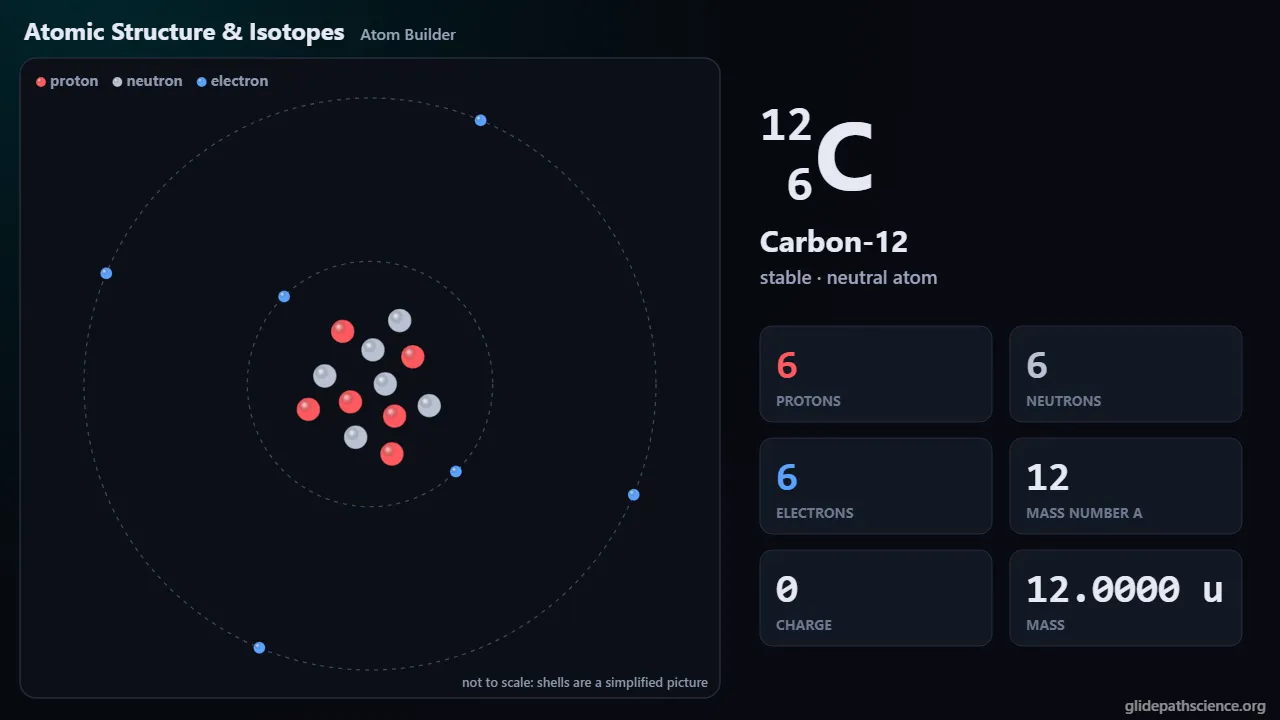
Students add and remove protons, neutrons, and electrons to see how the element, the isotope notation, the charge, and the nuclide's status follow, then learn why the atomic weight on the periodic table is an abundance-weighted average. A mass spectrometer bench, with a magnetic sector or a time-of-flight tube, sorts ions by mass-to-charge ratio with realistic peak widths and counting noise, and students measure the peaks to compute abundances and average masses themselves. An Isotope Explorer covers every element from hydrogen to krypton with exact masses, natural abundances, IUPAC standard atomic weights, and the chart of nuclides, and an Unknown Sample tab asks students to identify elements, mixtures, and molecules from their spectra. An Advanced track adds exact masses and the mass defect, how instruments sort ions, molecular isotope patterns, doubly charged ions, resolving power, and atomic-weight intervals.
What you'll learn
- Protons name it: the number of protons, Z, fixes the element, so changing the neutrons gives another isotope of the same element and changing the electrons gives an ion of it.
- Isotope notation: in ³⁷₁₇Cl⁻ the top number is the mass number A (protons plus neutrons), the bottom number is Z, and the charge is protons minus electrons, so every count follows from those three.
- A weighted average: no chlorine atom has a mass of 35.45 u, because each atom is ³⁵Cl or ³⁷Cl and 35.45 u is the average over a natural sample, weighted by how common each isotope is.
- Reading a spectrum: a mass spectrometer sorts ions by mass-to-charge ratio, and because each peak is one kind of ion with a size proportional to how many there were, a spectrum gives the abundances directly.
What you can do
- Guided walkthroughStep-by-step, in Intro and Advanced tracks.
- SandboxEvery control of the model, to explore freely.
- Virtual labA realistic experiment with measurement noise and data analysis.
- Concept checksQuestions about ideas and vocabulary, with no calculating.
- PredictionCommit to a prediction, then see the result.
- Classroom demoProjector mode and recordable clips for slides.
- Works offlineA single downloadable file, verified to run without a network.
Before you start
- Protons, neutrons, and electrons, and their charges
- Percentages and weighted averages
- Basic algebra (solving a linear equation for one unknown)
- For the Advanced track: kinetic energy, charges in magnetic fields, and simple probability
Run or download
Run it in your browser
Nothing to install and no account. Works on laptops, Chromebooks, tablets, and phones.
Launch Atomic Structure & IsotopesDownload for offline use
One HTML file (789 kB) that opens in any modern browser with no network: for rooms with unreliable Wi-Fi, or to keep a copy.
Download the fileFile details and checksum
- File
atomic-structure-isotopes-v1.5.html- Version
- 1.5, released November 15, 2026
- Build
9c4d198- Size
- 807,521 bytes
- SHA-256
fde8680749348ead5caaf4ff8f0b3549771705248f782a8fae77e5a93f9bf1fb- Offline
- Checked to run with all network access blocked.
The model and its limits
What the model assumes
- Exact isotopic masses and representative isotopic compositions come from the NIST table of atomic weights and isotopic compositions, and standard atomic weights, intervals, and conventional values from IUPAC (CIAAW), checked so that every element's abundances sum to 100 % and its weighted average matches its standard atomic weight.
- Each kind of ion is a Gaussian peak at its exact mass-to-charge ratio with a width set by the resolving power, and every bin receives Poisson-distributed counts on top of a small flat background.
- Molecular ions are computed exactly over every isotopic combination of every atom, and each ion has lost one electron (two for the optional doubly charged atomic ions, set at an illustrative share).
- Electron shells are counted from the usual filling order, with measured ground states used for the few free ions where that rule fails.
- Peaks are measured by their centroid and their ion count above the background, and unknown samples are fitted by nonnegative least squares, judged by chi-square per degree of freedom.
What it leaves out
- Molecules are ionized gently and stay whole, so the fragment ions of a real electron-impact spectrum do not appear.
- The instrument has no mass bias, detector dead time, peak tails, or background ions from its own gases.
- Every sample of an element has the representative composition, although real samples vary, which is why some atomic weights are intervals.
- The shell picture counts electrons per shell only and says nothing about orbital shapes or energies.
- Radioactive nuclides appear only as labels, and the range of known nuclides for each element is approximate.
Cite this simulation
APA 7
Meier, D. (2026). Atomic Structure & Isotopes (Version 1.5) [Computer simulation]. Glidepath Science. https://glidepathscience.org/simulations/atomic-structure-isotopes/
MLA 9
Meier, David. Atomic Structure & Isotopes. Version 1.5, Glidepath Science, 2026, glidepathscience.org/simulations/atomic-structure-isotopes/.
AIP
D. Meier, Atomic Structure & Isotopes, version 1.5 (Glidepath Science, 2026), https://glidepathscience.org/simulations/atomic-structure-isotopes/.
BibTeX
@misc{meier2026atomicstructureisotopes,
  author       = {Meier, David},
  title        = {{Atomic Structure & Isotopes}},
  year         = {2026},
  publisher    = {Glidepath Science},
  version      = {1.5},
  note         = {Interactive simulation, version 1.5},
  howpublished = {\url{https://glidepathscience.org/simulations/atomic-structure-isotopes/}},
  url          = {https://glidepathscience.org/simulations/atomic-structure-isotopes/}
}
Credits and license
Created by Dr. David Meier, Glidepath Science.
Licensed under Creative Commons Attribution-NonCommercial-ShareAlike 4.0 International (CC BY-NC-SA 4.0). You may share and adapt it for noncommercial purposes, such as teaching, with credit and under the same license. Licensing and reuse
AI tools (Claude, from Anthropic, and ChatGPT, from OpenAI) were used in developing Glidepath Science and its simulations. Dr. David Meier reviewed, edited, and modified every release version.