
NewVersion 1.2
Waves on a String
Send pulses down a string and a spring: see what sets their speed, how they reflect and pass through each other, and how standing waves pick out the harmonics; then measure them with a camera and a vibrator.
About this simulation
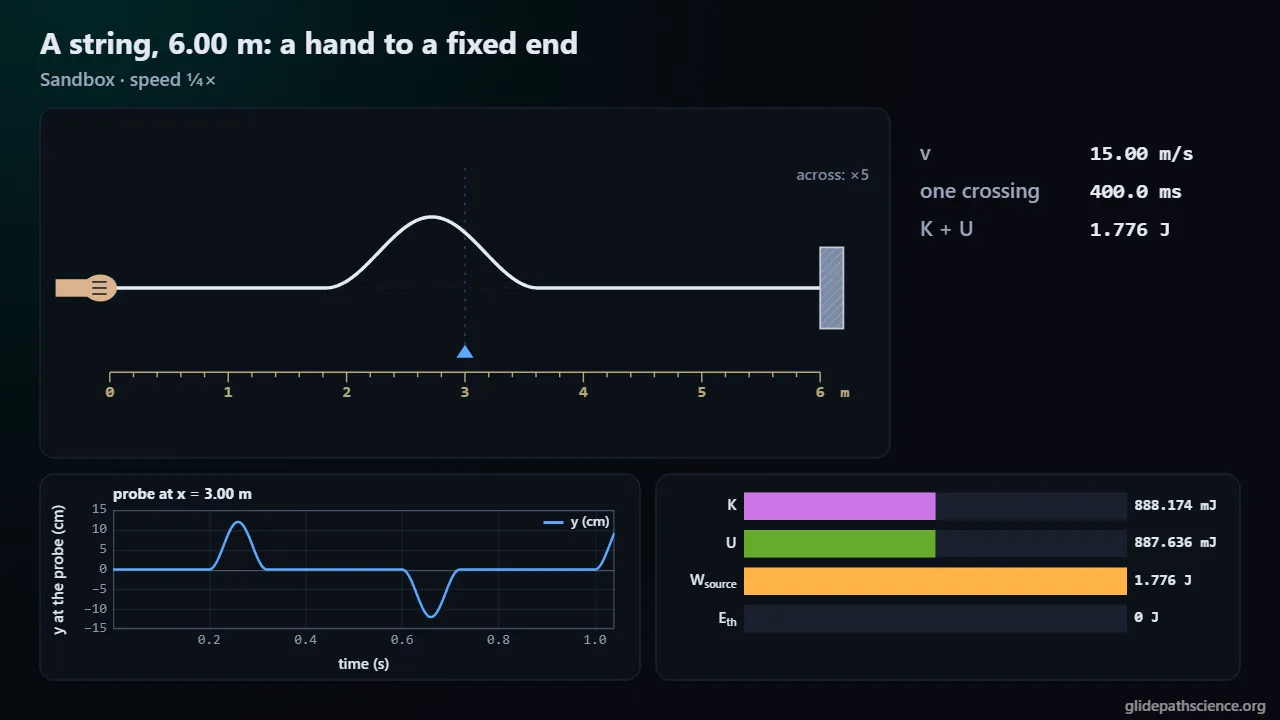
Mechanical waves in one dimension, on an exact finite-difference engine. Pulses from a hand show that the medium stays home and that only the tension and the mass per meter set the speed, v = √(F_T/μ), while one solution is drawn both across a string and along a spring. Pulses reflect inverted from a clamp and upright from a free ring, split at knots between ropes, and pass through each other; a hand shaking steadily gives v = fλ and the sine-wave function, and two opposite waves make standing waves with harmonics f_n = nv/2L. A Pulse Lab films a pulse with a high-speed camera, fits its position frame by frame, plots v² against a tension gauge to find μ, and measures a knot’s reflection; a Standing-Wave Lab (a vibrator, a pulley, and hanging masses) finds the harmonics, fits mass against 1/n², uses a strobe, plays the string’s tone, and, in Advanced, traces a resonance curve and a ring-down for Q. The Advanced track covers the wave equation and d’Alembert’s solution, impedance, energy flux and a matched dashpot, modes for every pair of ends, plucks and Young’s rule, resonance and Q, a slinky’s two speeds and its cutoff as a chain of turns, a hanging rope, and tension modulation.
What you'll learn
- Explain that a wave carries a shape and energy while the medium moves and returns, and tell transverse from longitudinal waves.
- Use v = √(F_T/μ) and v = fλ, and explain why the amplitude and the frequency do not change a wave’s speed.
- Predict the reflections at fixed and free ends and at knots between ropes, and apply superposition to overlapping pulses.
- Find the harmonics of a string, f_n = nv/2L, and measure them with a vibrator, a pulley, and hanging masses.
What you can do
- Guided walkthroughStep-by-step, in Intro and Advanced tracks.
- SandboxEvery control of the model, to explore freely.
- Virtual labA realistic experiment with measurement noise and data analysis.
- Concept checksQuestions about ideas and vocabulary, with no calculating.
- PredictionCommit to a prediction, then see the result.
- Classroom demoProjector mode and recordable clips for slides.
- Works offlineA single downloadable file, verified to run without a network.
Before you start
- Newton’s laws and tension in a rope
- Sine functions and their period and amplitude
- For the Advanced track: partial derivatives, complex numbers, and damped, driven oscillators
Run or download
Run it in your browser
Nothing to install and no account. Works on laptops, Chromebooks, tablets, and phones.
Launch Waves on a StringDownload for offline use
One HTML file (1.0 MB) that opens in any modern browser with no network: for rooms with unreliable Wi-Fi, or to keep a copy.
Download the fileFile details and checksum
- File
waves-on-a-string-v1.2.html- Version
- 1.2, released November 15, 2026
- Build
53dfe69- Size
- 1,075,555 bytes
- SHA-256
f968a6868b23faaee2f8e9aa41214910cbea20de6f7f8815d0a1da70d7f06d55- Offline
- Checked to run with all network access blocked.
The model and its limits
What the model assumes
- The linear one-dimensional wave equation in conservative form, with viscous and internal damping; strings, springs, and a rope whose tension varies with height.
- Leapfrog finite differences on a travel-time grid, exact at the grid nodes for uniform pieces and knots, with energy books that close to round-off.
- Ends that are fixed, free, absorbing, held by a hand, or (Advanced) a dashpot, a mass, or a spring; knots join pieces under one tension.
- The standing-wave bench as exact damped, driven modes driven through the vibrator’s moving end.
- Tension modulation (Kirchhoff and Carrier) only in one Advanced step.
- Illustrative lab values: string densities, vibrator amplitudes, damping rates, pulley friction, the elastic cord, and instrument errors.
What it leaves out
- No bending stiffness, so no inharmonicity of real strings.
- No gravity sag, second transverse direction, whirling, or longitudinal string waves.
- Sound radiation and air loading are folded into a damping rate.
- Small slopes only; displays magnify displacement, with the scale stated.
- Slinky turns that touch are warned, not modeled; no dropped slinky.
- One dimension only; beats and Fourier series are left to later sims.
Cite this simulation
APA 7
Meier, D. (2026). Waves on a String (Version 1.2) [Computer simulation]. Glidepath Science. https://glidepathscience.org/simulations/waves-on-a-string/
MLA 9
Meier, David. Waves on a String. Version 1.2, Glidepath Science, 2026, glidepathscience.org/simulations/waves-on-a-string/.
AIP
D. Meier, Waves on a String, version 1.2 (Glidepath Science, 2026), https://glidepathscience.org/simulations/waves-on-a-string/.
BibTeX
@misc{meier2026wavesonastring,
  author       = {Meier, David},
  title        = {{Waves on a String}},
  year         = {2026},
  publisher    = {Glidepath Science},
  version      = {1.2},
  note         = {Interactive simulation, version 1.2},
  howpublished = {\url{https://glidepathscience.org/simulations/waves-on-a-string/}},
  url          = {https://glidepathscience.org/simulations/waves-on-a-string/}
}
Credits and license
Created by Dr. David Meier, Glidepath Science.
Based on: OpenStax, University Physics Volume 1, by Samuel J. Ling, Jeff Sanny and William Moebs: Chapter 16, “Waves,” an open textbook licensed CC BY-NC-SA 4.0. The Intro track follows its order of topics and its notation (F_T for the tension, μ, the wave function, the wave speed and power, and the harmonics of a string), except that pulses, reflection, and superposition come first; the wording, figures, numbers, and simulations are the lab’s own. No endorsement by the authors is implied.
Licensed under Creative Commons Attribution-NonCommercial-ShareAlike 4.0 International (CC BY-NC-SA 4.0). You may share and adapt it for noncommercial purposes, such as teaching, with credit and under the same license. Licensing and reuse
AI tools (Claude, from Anthropic, and ChatGPT, from OpenAI) were used in developing Glidepath Science and its simulations. Dr. David Meier reviewed, edited, and modified every release version.