
NewVersion 1.1
Faraday's Law & Generators
Push a magnet through a coil, slide a rod on rails, spin a generator and drop a magnet down a copper pipe: a changing flux drives an EMF that opposes the change.
About this simulation
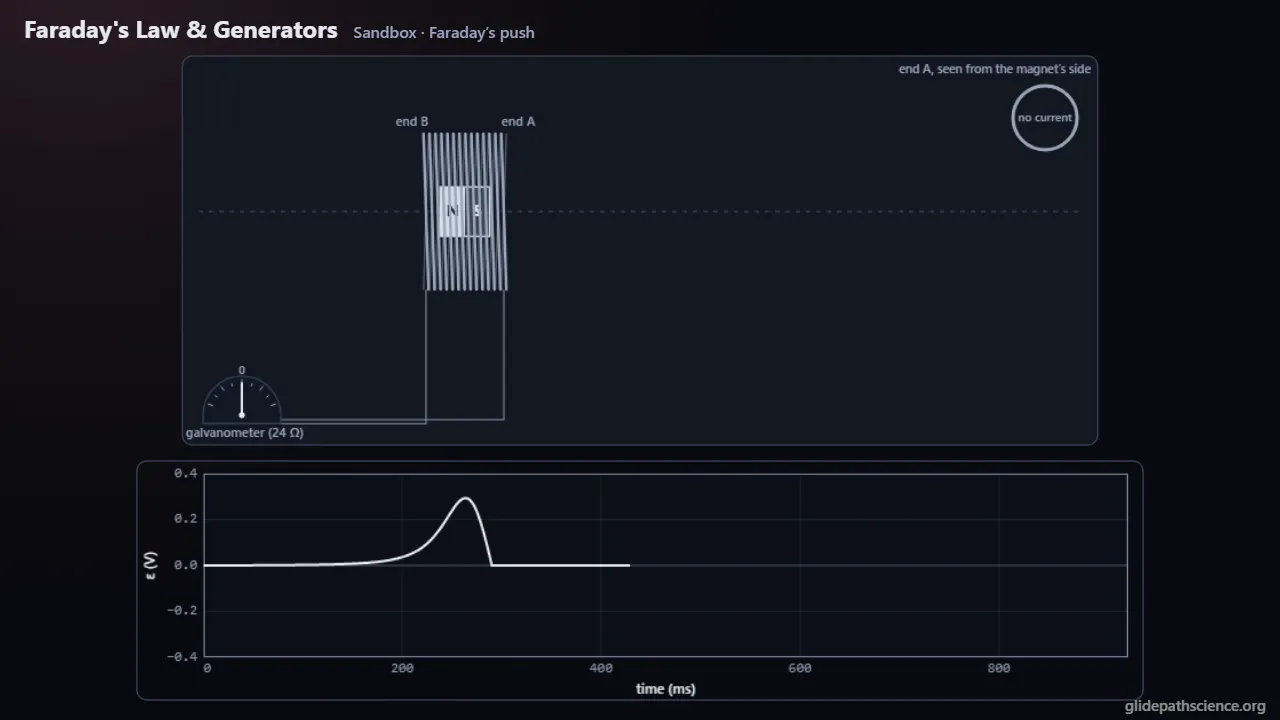
Why does a magnet fall slowly through a copper pipe, and why is a loaded generator hard to turn? Students push, pull and drop a magnet through a coil on a galvanometer or a voltage sensor, turn and stretch a loop in a uniform field, drive a rod along rails, and spin a generator with slip rings, a split ring, two coils or three phases into a resistor or a 6 V lamp. A guided walkthrough at two levels runs from magnetic flux through Faraday’s and Lenz’s laws, the rod on rails and its terminal speed, to the generator under load and the magnet in the pipe; the Advanced track adds the induced electric field and two voltmeters that disagree, the commutator, the pipe ring by ring and Faraday’s disk. An Induction Bench logs a falling magnet’s pulses to measure flux linkage and g, a Generator Bench reads the crank’s torque under each load, and a Brake Lab times magnets down pipes of copper, aluminum, brass and plastic. Concept challenges and a prediction lab with fresh numbers round it out.
What you'll learn
- Compute magnetic flux, Φ = BA cos θ, and explain that an EMF, ε = −N dΦ/dt, appears only while the flux changes, whether by moving a magnet, turning or stretching a loop, or changing the field.
- Use Lenz’s law to find the direction of an induced current, which repels an approaching magnet and holds back a leaving one, so work must always be done to make the current.
- Find the EMF of a rod moving across a field, ε = BLv, and the force ILB against its motion, and show that the power supplied, Fv, is exactly the I²R that heats the circuit.
- Explain how a coil turning in a field makes ε = NBAω sin ωt, why a load makes a generator harder to turn, and how eddy currents turn motion into heat and slow a magnet falling through copper.
What you can do
- Guided walkthroughStep-by-step, in Intro and Advanced tracks.
- SandboxEvery control of the model, to explore freely.
- Virtual labA realistic experiment with measurement noise and data analysis.
- Concept checksQuestions about ideas and vocabulary, with no calculating.
- PredictionCommit to a prediction, then see the result.
- Classroom demoProjector mode and recordable clips for slides.
- Works offlineA single downloadable file, verified to run without a network.
Before you start
- Magnetic fields of magnets and currents, and the magnetic force on a current
- Ohm’s law, power and energy in circuits
- For the Advanced track: integrals, first-order differential equations, and line integrals
Run or download
Run it in your browser
Nothing to install and no account. Works on laptops, Chromebooks, tablets, and phones.
Launch Faraday's Law & GeneratorsDownload for offline use
One HTML file (957 kB) that opens in any modern browser with no network: for rooms with unreliable Wi-Fi, or to keep a copy.
Download the fileFile details and checksum
- File
faradays-law-generators-v1.1.html- Version
- 1.1, released November 15, 2026
- Build
fe131bb- Size
- 979,705 bytes
- SHA-256
35b33d30758c6648059612a7026e6188274f394ea05a2d63a0973459f2fd5039- Offline
- Checked to run with all network access blocked.
The model and its limits
What the model assumes
- The magnet is a uniformly magnetized cylinder, computed exactly inside and out, or a point dipole where a step says so; the standard magnet is a ½-inch NdFeB cylinder.
- A coil’s flux linkage is summed over sample turns with exact slopes, so the EMF and the force on the magnet satisfy Fv = −εI and every energy book balances.
- Loops in a uniform field and the rod on rails are closed forms; the generator is a rigid coil in a uniform field, and the 6 V lamp is a tungsten filament that warms with its current.
- Eddy currents in a pipe are summed ring by ring for thin conductors at low speed, with thick walls split into layers and a lengthwise slit treated separately.
- The Induction Bench uses an illustrative 10 kHz logger with noise and a hidden release delay, so repeated drops scatter like a real lab’s.
What it leaves out
- The model is quasi-static: self-inductance and the induced currents’ own fields are left out, which holds while a coil’s L/R is short against the time a magnet takes to pass.
- No skin depth, no iron cores or hysteresis, no magnets tilting, spinning or touching the pipe, and conductivities that do not change with temperature.
- No armature reaction or brush sparking in the generator, and no transformers or AC circuits.
- The scenes are two-dimensional drawings from fixed viewpoints.
Cite this simulation
APA 7
Meier, D. (2026). Faraday's Law & Generators (Version 1.1) [Computer simulation]. Glidepath Science. https://glidepathscience.org/simulations/faradays-law-generators/
MLA 9
Meier, David. Faraday's Law & Generators. Version 1.1, Glidepath Science, 2026, glidepathscience.org/simulations/faradays-law-generators/.
AIP
D. Meier, Faraday's Law & Generators, version 1.1 (Glidepath Science, 2026), https://glidepathscience.org/simulations/faradays-law-generators/.
BibTeX
@misc{meier2026faradayslawgenerators,
  author       = {Meier, David},
  title        = {{Faraday's Law & Generators}},
  year         = {2026},
  publisher    = {Glidepath Science},
  version      = {1.1},
  note         = {Interactive simulation, version 1.1},
  howpublished = {\url{https://glidepathscience.org/simulations/faradays-law-generators/}},
  url          = {https://glidepathscience.org/simulations/faradays-law-generators/}
}
Credits and license
Created by Dr. David Meier, Glidepath Science.
Based on: OpenStax, University Physics Volume 2, by Samuel J. Ling, Jeff Sanny and William Moebs: Chapter 13, “Electromagnetic Induction,” §13.1–13.6, an open textbook licensed CC BY-NC-SA 4.0 (openstax.org). The order of topics and the notation follow it; the text, numbers, figures and simulations are this lab’s own. No endorsement by the authors or OpenStax is implied.
Licensed under Creative Commons Attribution-NonCommercial-ShareAlike 4.0 International (CC BY-NC-SA 4.0). You may share and adapt it for noncommercial purposes, such as teaching, with credit and under the same license. Licensing and reuse
AI tools (Claude, from Anthropic, and ChatGPT, from OpenAI) were used in developing Glidepath Science and its simulations. Dr. David Meier reviewed, edited, and modified every release version.