
NewVersion 1.1
Exoplanet Detection Lab
Watch a planet dim its star and make it wobble, read its size from the transit and its mass from the Doppler shift, fit noisy data, and hunt for planets among eclipsing binaries.
About this simulation
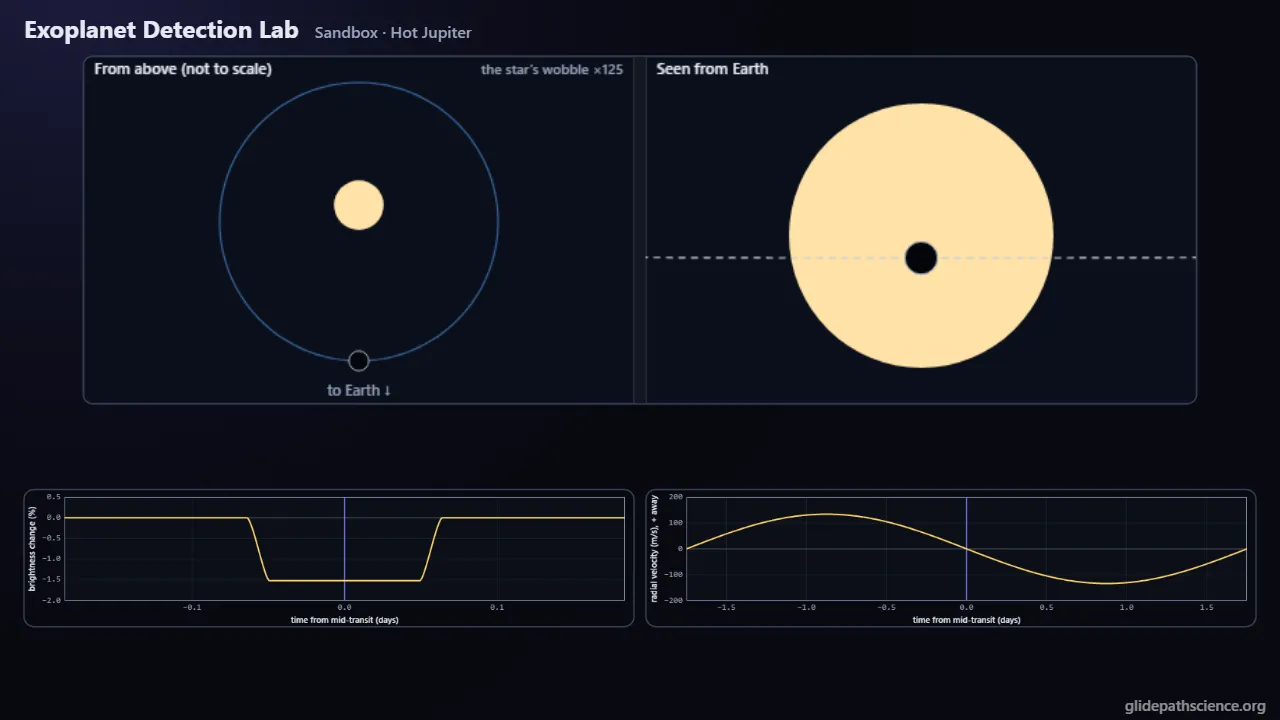
One star, one planet, two signals. Students watch a planet cross its star’s disk and dim it by δ = (Rp/Rs)², and watch the star wobble toward and away from us. A guided walkthrough at two levels reads the transit depth for the planet’s radius, the period and Kepler’s third law for its orbit, the radial-velocity curve for its minimum mass, and both together for its density; the Advanced track adds impact parameter and durations, limb darkening, the star’s density, box searches and folding, eccentric orbits, χ² fitting, false positives and selection bias. The Sandbox puts the orbit from above, the disk seen from Earth, the light curve and the RV curve on one clock, with presets from a hot Jupiter to an Earth twin. A Transit Fitter folds thirty days of noisy photometry and fits it by hand or by least squares; a Wobble Fitter fits thirty radial velocities for a minimum mass; Planet Hunt asks which of six stars hosts a planet and which only mimics one. A concept challenge and a prediction lab round it out.
What you'll learn
- Explain that a transiting planet blocks the fraction δ = (Rp/Rs)² of its star’s light, read the period from the time between dips, and use Kepler’s third law to turn the period into the orbit’s size.
- Explain how the star’s Doppler shift, as star and planet orbit their center of mass, gives the planet’s minimum mass, Mp sin i, and how a transit fixes i so that both methods together give the density.
- Explain why folding N transits lowers the scatter as 1/√N, and how a fit judged by χ² gives each value and its uncertainty.
- Recognize how eclipsing binaries, grazing orbits and spotted stars mimic planets, and explain why both methods favor big planets close to their stars, so the planets found are not a fair sample.
What you can do
- Guided walkthroughStep-by-step, in Intro and Advanced tracks.
- SandboxEvery control of the model, to explore freely.
- Virtual labA realistic experiment with measurement noise and data analysis.
- Concept checksQuestions about ideas and vocabulary, with no calculating.
- PredictionCommit to a prediction, then see the result.
- Classroom demoProjector mode and recordable clips for slides.
- Works offlineA single downloadable file, verified to run without a network.
Before you start
- Circular orbits, gravitation and Kepler’s laws
- The Doppler shift for light
- For the Advanced track: least-squares fitting, χ² and standard errors, and eccentric orbits
Run or download
Run it in your browser
Nothing to install and no account. Works on laptops, Chromebooks, tablets, and phones.
Launch Exoplanet Detection LabDownload for offline use
One HTML file (794 kB) that opens in any modern browser with no network: for rooms with unreliable Wi-Fi, or to keep a copy.
Download the fileFile details and checksum
- File
exoplanet-detection-lab-v1.1.html- Version
- 1.1, released November 15, 2026
- Build
ca46500- Size
- 813,470 bytes
- SHA-256
d795bb79593abce28e3bdc61e517bf695863aa2bd3820e7a9591c2d53a21ae4c- Offline
- Checked to run with all network access blocked.
The model and its limits
What the model assumes
- Two bodies on a Keplerian orbit, circular in Intro and eccentric in Advanced, solved with Kepler’s equation by the library’s shared gravitation engine.
- The transit is the exact overlap of two circles for a uniform star, with quadratic limb darkening added by integrating over 120 rings of the star.
- Noise is Gaussian and white, from a seeded generator; the Advanced Wobble Fitter adds 3 m/s of stellar jitter that its error bars leave out.
- Fits use Levenberg–Marquardt least squares with the data’s own error bars; in the Transit Fitter, b, Rp/Rs and a/Rs get 1σ ranges from a profile of χ².
- Planet Hunt’s impostors are illustrative: a diluted eclipsing binary of two uniform stars, and a spotted star as a two-term sine.
What it leaves out
- No light from the planet itself (phase curves and secondary eclipses), and no atmospheres or transmission spectra.
- No starspots crossed during a transit, granulation, flares or stellar oscillations beyond the jitter and the spotted star; no exposure-time smearing, light travel time or relativistic Doppler terms.
- One planet only: no pull of other planets, no transit-timing variations and no tides.
- Direct imaging and microlensing are not shown, and the planet populations are illustrative, not drawn from survey catalogs.
Cite this simulation
APA 7
Meier, D. (2026). Exoplanet Detection Lab (Version 1.1) [Computer simulation]. Glidepath Science. https://glidepathscience.org/simulations/exoplanet-detection-lab/
MLA 9
Meier, David. Exoplanet Detection Lab. Version 1.1, Glidepath Science, 2026, glidepathscience.org/simulations/exoplanet-detection-lab/.
AIP
D. Meier, Exoplanet Detection Lab, version 1.1 (Glidepath Science, 2026), https://glidepathscience.org/simulations/exoplanet-detection-lab/.
BibTeX
@misc{meier2026exoplanetdetectionlab,
  author       = {Meier, David},
  title        = {{Exoplanet Detection Lab}},
  year         = {2026},
  publisher    = {Glidepath Science},
  version      = {1.1},
  note         = {Interactive simulation, version 1.1},
  howpublished = {\url{https://glidepathscience.org/simulations/exoplanet-detection-lab/}},
  url          = {https://glidepathscience.org/simulations/exoplanet-detection-lab/}
}
Credits and license
Created by Dr. David Meier, Glidepath Science.
Licensed under Creative Commons Attribution-NonCommercial-ShareAlike 4.0 International (CC BY-NC-SA 4.0). You may share and adapt it for noncommercial purposes, such as teaching, with credit and under the same license. Licensing and reuse
AI tools (Claude, from Anthropic, and ChatGPT, from OpenAI) were used in developing Glidepath Science and its simulations. Dr. David Meier reviewed, edited, and modified every release version.