
NewVersion 1.5
Three-Body Lab
Two bodies follow Kepler's ellipses; add a third and the formulas run out. Lagrange points, Trojan tadpoles, gravity assists, the figure-eight, measurable chaos, and the integrators that make orbits trustworthy.
About this simulation
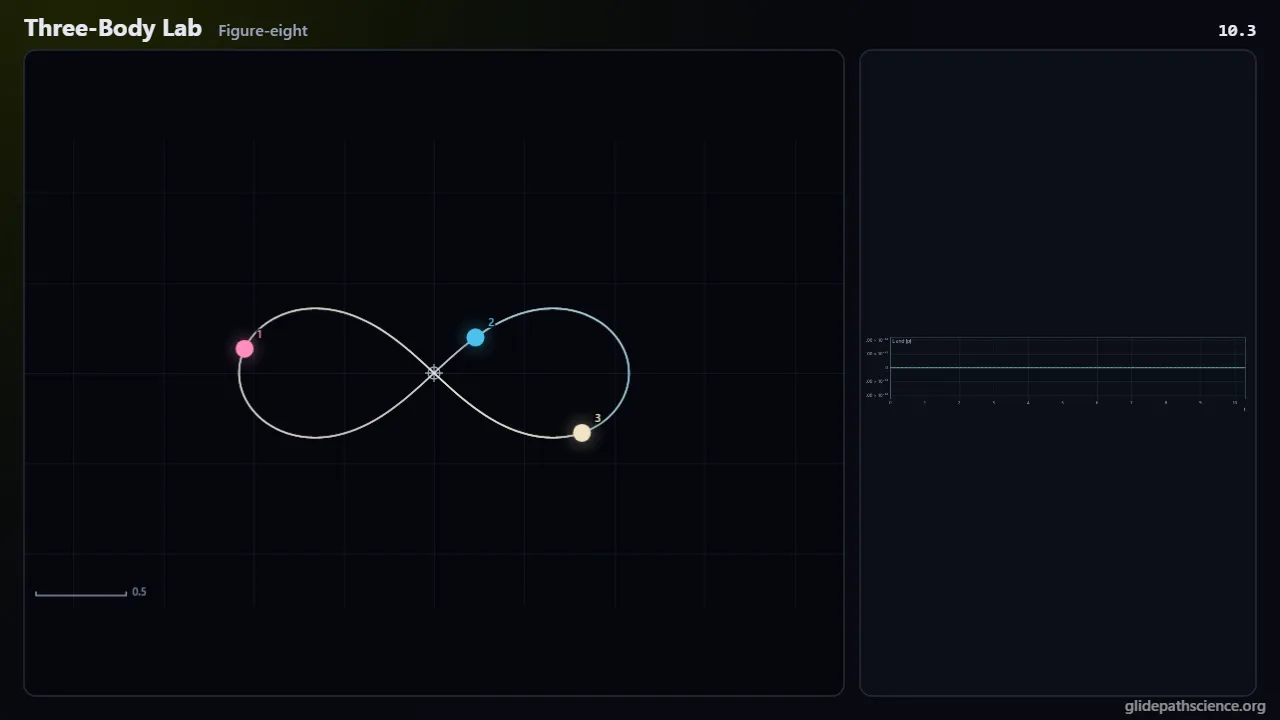
Gravitational dynamics integrated from F = ma. Students start with two bodies (the center of mass, circular and escape speeds, equal areas from angular momentum), then add a third: Burrau's Pythagorean problem shows a bound system ejecting its lightest body, Lagrange's triangle turns rigidly yet tears apart unless one mass dominates, and the figure-eight shows order inside chaos. The restricted three-body problem, drawn in the frame that turns with two primaries, gives the five Lagrange points, the Jacobi constant and the zero-velocity curves whose gates open as the energy rises, Trojan tadpoles and horseshoes held by the Coriolis force, and periodic orbits solved live by differential correction. Gravity assists are integrated in the full Sun-planet problem beside the patched-conic picture. A Chaos Lab measures Lyapunov exponents with shadow twins, maps which body is thrown out for every starting triangle (with any pixel replayed bit for bit), and runs time backward; an Integrator Lab compares seven integrators, measures their orders, and shows why regularization is needed for close encounters. Scaled units with G = 1 for many-body scenes; SI for named systems such as Earth and Moon, Sun and Earth, and Sun and Jupiter.
What you'll learn
- Describe two-body motion as conic sections about the center of mass, and compute circular and escape speeds and speeds from conservation of angular momentum.
- Locate the five Lagrange points of the restricted three-body problem, explain why L4 and L5 can hold Trojan asteroids, and use the Jacobi constant to decide where a spacecraft can go.
- Explain why the three-body problem has no general formula, and measure how exponential divergence limits the time over which a chaotic system can be predicted.
- Compare numerical integrators by their order and their long-term energy behavior, and explain why conserving energy is necessary but not sufficient for an accurate computed orbit.
What you can do
- Guided walkthroughStep-by-step, in Intro and Advanced tracks.
- SandboxEvery control of the model, to explore freely.
- Virtual labA realistic experiment with measurement noise and data analysis.
- Concept checksQuestions about ideas and vocabulary, with no calculating.
- PredictionCommit to a prediction, then see the result.
- Classroom demoProjector mode and recordable clips for slides.
- Works offlineA single downloadable file, verified to run without a network.
Before you start
- Newton's law of gravitation, circular motion and centripetal force
- Kinetic and gravitational potential energy, and angular momentum
- For the Advanced track: Lagrangian or Hamiltonian mechanics, linear stability analysis, and some programming or numerical methods
Run or download
Run it in your browser
Nothing to install and no account. Works on laptops, Chromebooks, tablets, and phones.
Launch Three-Body LabDownload for offline use
One HTML file (1016 kB) that opens in any modern browser with no network: for rooms with unreliable Wi-Fi, or to keep a copy.
Download the fileFile details and checksum
- File
three-body-lab-v1.5.html- Version
- 1.5, released November 15, 2026
- Build
9b79ed6- Size
- 1,039,943 bytes
- SHA-256
7286f5037c292005366a01e8573b8bc859c0c3d9a118c18db045c9271358a08f- Offline
- Checked to run with all network access blocked.
The model and its limits
What the model assumes
- Point masses moving in a plane under Newtonian gravity, in double precision.
- Scaled units with G = 1 for many-body scenes; named systems use SI constants shared with the Ephemeris Orrery (IAU and JPL values).
- Seven integrators: explicit Euler, symplectic Euler, leapfrog, classic Runge-Kutta, Yoshida's fourth-order composition, adaptive Dormand-Prince 5(4), and the logarithmic-Hamiltonian (LogH) leapfrog for algorithmic regularization of close encounters.
- The restricted problem's primaries move on circles; particles stop at a primary's real radius or when they leave the system.
- A run ends for a physical reason (an escape, a collision with a physical radius, whole periods of a periodic orbit) or at a stated safety cap.
- Gravity assists in the Lagrange Lab are integrated in the full Sun-planet restricted problem; the walkthrough's patched-conic picture treats the planet as moving in a straight line during the encounter.
- The free-fall fate map was computed with LogH-4 at a fixed fictitious step; replaying any pixel reproduces it exactly.
What it leaves out
- Planar motion only: no halo orbits, inclined Trojans or Kozai-Lidov cycles.
- No tides, mergers, spin or oblateness; N-body scenes treat stars and planets as points.
- Circular primaries in the restricted problem; the Earth-Moon problem leaves out the Sun, and flybys leave out other planets.
- No relativity, radiation pressure or solar wind.
- Double precision limits how long an unstable orbit can be followed.
- Published initial conditions (the figure-eight, the 2013 periodic families) are quoted to 8 and 6 digits; the unstable families hold for only a period or two.
Cite this simulation
APA 7
Meier, D. (2026). Three-Body Lab (Version 1.5) [Computer simulation]. Glidepath Science. https://glidepathscience.org/simulations/three-body-lab/
MLA 9
Meier, David. Three-Body Lab. Version 1.5, Glidepath Science, 2026, glidepathscience.org/simulations/three-body-lab/.
AIP
D. Meier, Three-Body Lab, version 1.5 (Glidepath Science, 2026), https://glidepathscience.org/simulations/three-body-lab/.
BibTeX
@misc{meier2026threebodylab,
  author       = {Meier, David},
  title        = {{Three-Body Lab}},
  year         = {2026},
  publisher    = {Glidepath Science},
  version      = {1.5},
  note         = {Interactive simulation, version 1.5},
  howpublished = {\url{https://glidepathscience.org/simulations/three-body-lab/}},
  url          = {https://glidepathscience.org/simulations/three-body-lab/}
}
Credits and license
Created by Dr. David Meier, Glidepath Science.
Licensed under Creative Commons Attribution-NonCommercial-ShareAlike 4.0 International (CC BY-NC-SA 4.0). You may share and adapt it for noncommercial purposes, such as teaching, with credit and under the same license. Licensing and reuse
AI tools (Claude, from Anthropic, and ChatGPT, from OpenAI) were used in developing Glidepath Science and its simulations. Dr. David Meier reviewed, edited, and modified every release version.