
NewVersion 1.1
Inductance & LC Oscillations
Switch a coil on and off to see its current rise slowly and its voltage kick, then trade its magnetic energy with a capacitor in an LC circuit that rings like a spring.
About this simulation
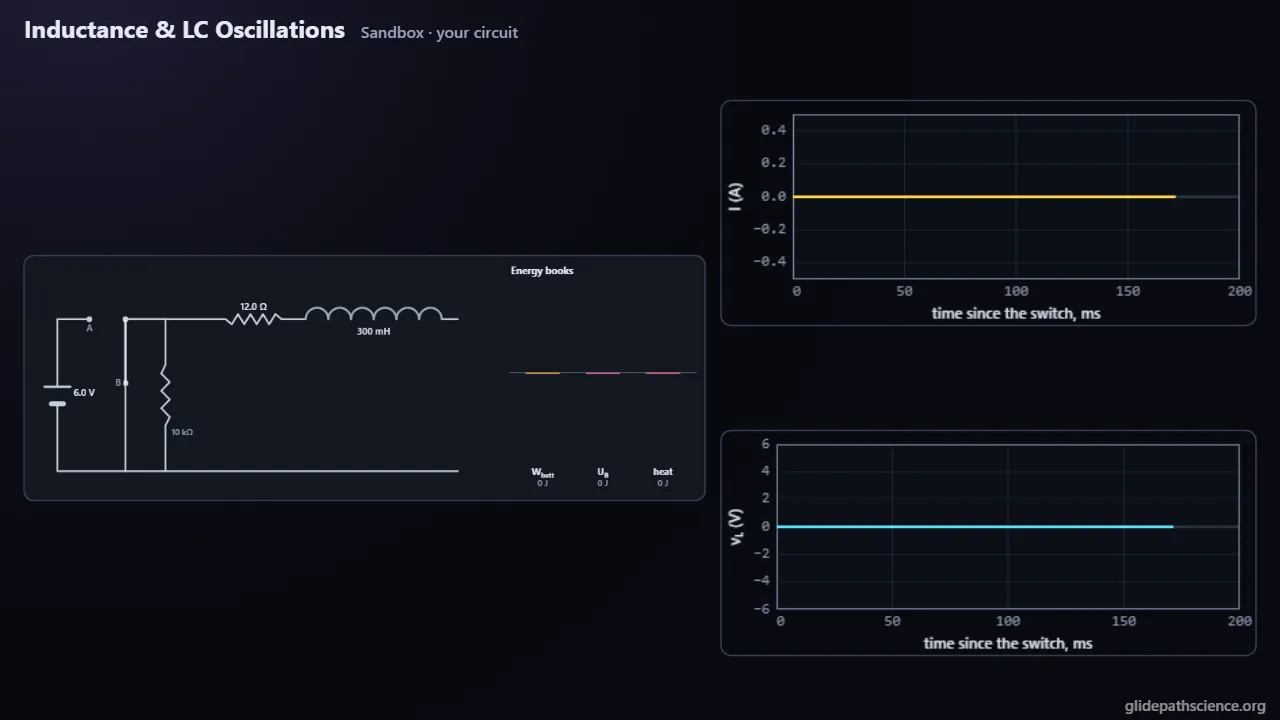
Why does a coil fight every change in its current? Students wire one loop of a battery, a switch, a resistor, a coil, a capacitor and a flyback diode to a two-channel scope: the RL rise and decay, the kick when the switch opens and the diode that tames it, and LC rings in all three damping regimes, with energy books that balance. A guided walkthrough at two levels runs from back emf and L = NΦ/I through the RL time constant, the kick and ½LI² to the LC circuit and its spring analogy; the Advanced track adds the RL equation, a toroid, mutual inductance and coupling, critical damping, Q, and coupled loops and beats. An RL Scope builds a coil from its turns, radius, length and core and measures τ against L/R; LC ↔ Spring runs a circuit beside a mass on a spring at real speed; and Coupled Coils shows the mutual inductance and coupling coefficient change as one coil is dragged and tilted. Concept challenges and a prediction lab with Tune the circuit round it out.
What you'll learn
- Explain how a coil’s own changing flux induces ε = −L dI/dt against the change, and find its inductance, L = NΦ/I, which is μ₀N²A/ℓ for a solenoid.
- Use τ = L/R to describe the current’s rise and fall, 63 % of the way in one time constant, and explain why opening the switch makes the coil kick back with whatever voltage it takes.
- Find the energy stored in a coil, U = ½LI², as the energy density B²/2μ₀ summed over its magnetic field.
- Explain how energy swaps between a capacitor and a coil at ω = 1/√(LC), as a mass on a spring swaps kinetic and elastic energy, and how resistance damps the swing and coupling passes it to another circuit.
What you can do
- Guided walkthroughStep-by-step, in Intro and Advanced tracks.
- SandboxEvery control of the model, to explore freely.
- Virtual labA realistic experiment with measurement noise and data analysis.
- Concept checksQuestions about ideas and vocabulary, with no calculating.
- PredictionCommit to a prediction, then see the result.
- Classroom demoProjector mode and recordable clips for slides.
- Works offlineA single downloadable file, verified to run without a network.
Before you start
- Faraday’s and Lenz’s laws (Faraday’s Law & Generators)
- Capacitors and RC circuits (the RC Circuit Lab)
- For the Advanced track: first- and second-order linear differential equations, and the damped harmonic oscillator
Run or download
Run it in your browser
Nothing to install and no account. Works on laptops, Chromebooks, tablets, and phones.
Launch Inductance & LC OscillationsDownload for offline use
One HTML file (730 kB) that opens in any modern browser with no network: for rooms with unreliable Wi-Fi, or to keep a copy.
Download the fileFile details and checksum
- File
inductance-lc-oscillations-v1.1.html- Version
- 1.1, released November 15, 2026
- Build
3d79965- Size
- 747,087 bytes
- SHA-256
bf6c55e7a8e3bee78ed826a093f722f650da7cb07c713f5f6ab3cb637840334d- Offline
- Checked to run with all network access blocked.
The model and its limits
What the model assumes
- Lumped, ideal parts: a battery with no internal resistance, ideal wires and switch, a coil whose wire resistance is counted in R, and an ideal capacitor.
- Each stretch between switch moves is solved in closed form, so an ideal LC circuit keeps its energy forever; only a stretch through the diode is integrated numerically.
- Opened with no diode, the coil’s current flows on through a 10 kΩ bleeder, so its voltage jumps and dies away in tens of microseconds; the diode follows Shockley’s equation.
- Long solenoids use L = μ₀N²A/ℓ and short coils Wheeler’s formula; two coils’ mutual inductance is summed over rings by Maxwell’s formula, or by Neumann’s integral when one is tilted.
- The circuits’ sweeps run in slow motion on screen, while the LC ↔ Spring tab runs at real speed, with parts chosen to ring at about one hertz.
What it leaves out
- No capacitance between a coil’s turns, which in a real coil limits the kick and makes it ring at megahertz.
- Iron cores are linear, with one fixed permeability and no saturation or hysteresis.
- No spark physics, no skin or proximity effects in the wire, and no radiation.
- No driven AC circuits or resonance curves (AC Circuits, Resonance & Transformers), and the Intro track leaves out a long solenoid’s end correction.
Cite this simulation
APA 7
Meier, D. (2026). Inductance & LC Oscillations (Version 1.1) [Computer simulation]. Glidepath Science. https://glidepathscience.org/simulations/inductance-lc-oscillations/
MLA 9
Meier, David. Inductance & LC Oscillations. Version 1.1, Glidepath Science, 2026, glidepathscience.org/simulations/inductance-lc-oscillations/.
AIP
D. Meier, Inductance & LC Oscillations, version 1.1 (Glidepath Science, 2026), https://glidepathscience.org/simulations/inductance-lc-oscillations/.
BibTeX
@misc{meier2026inductancelcoscillations,
  author       = {Meier, David},
  title        = {{Inductance & LC Oscillations}},
  year         = {2026},
  publisher    = {Glidepath Science},
  version      = {1.1},
  note         = {Interactive simulation, version 1.1},
  howpublished = {\url{https://glidepathscience.org/simulations/inductance-lc-oscillations/}},
  url          = {https://glidepathscience.org/simulations/inductance-lc-oscillations/}
}
Credits and license
Created by Dr. David Meier, Glidepath Science.
Based on: OpenStax, University Physics Volume 2, by Samuel J. Ling, Jeff Sanny and William Moebs: Chapter 14, “Inductance,” §14.1–14.6, an open textbook licensed CC BY-NC-SA 4.0 (openstax.org). The tracks follow its topics and its notation (the Intro takes self-inductance before mutual inductance); the text, numbers, figures and simulations are this lab’s own. No endorsement by OpenStax or the authors is implied.
Licensed under Creative Commons Attribution-NonCommercial-ShareAlike 4.0 International (CC BY-NC-SA 4.0). You may share and adapt it for noncommercial purposes, such as teaching, with credit and under the same license. Licensing and reuse
AI tools (Claude, from Anthropic, and ChatGPT, from OpenAI) were used in developing Glidepath Science and its simulations. Dr. David Meier reviewed, edited, and modified every release version.