
NewVersion 1.1
Special Relativity & Spacetime
One speed of light for everyone, so clocks and rulers disagree: light clocks, time dilation, contraction, the lightning train, spacetime diagrams, a twin's voyage by birthday signals, muons and GPS clocks.
About this simulation
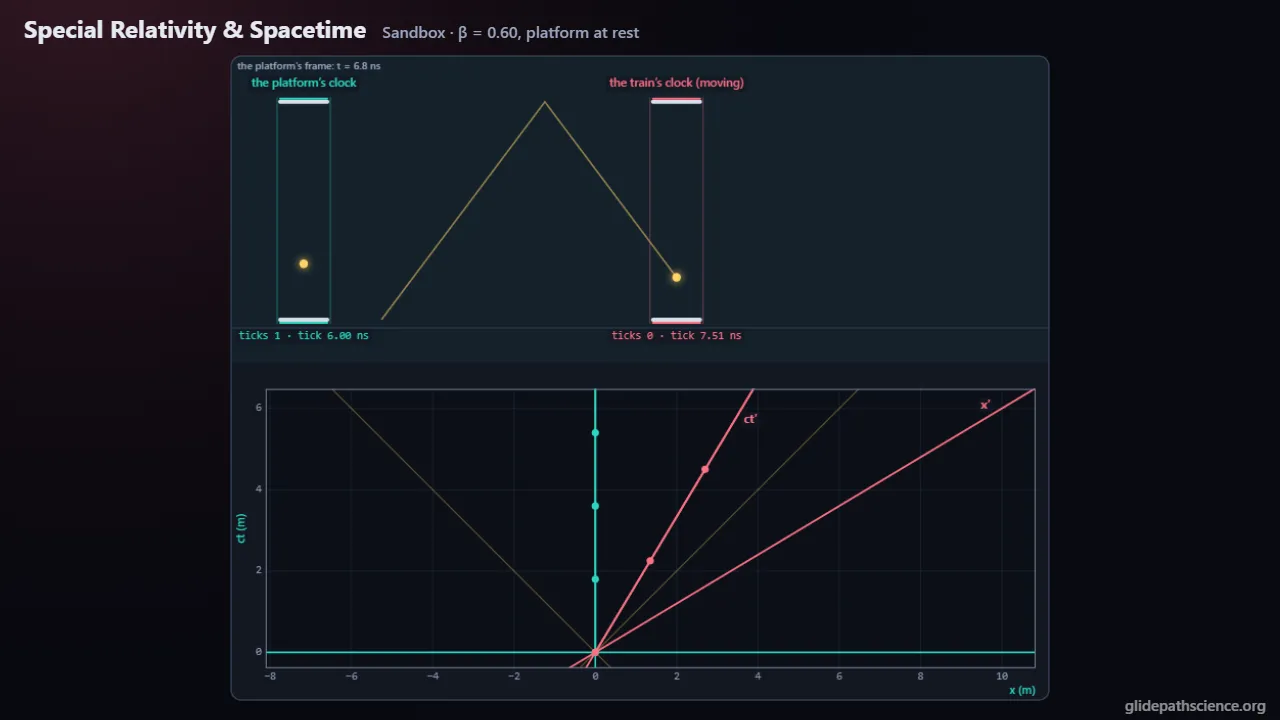
Every observer measures the same speed of light, and everything else follows. A light clock on a passing train ticks slow in the platform's frame by the factor γ, which students derive from the photon's slanted path. A guided walkthrough at two levels follows the topics of OpenStax University Physics Volume 3's relativity chapter: light that does not add to its source's speed, the two postulates, the light clock, γ, proper time, muons reaching the ground in both frames, length contraction, the lightning on the train, the twin paradox, GPS clocks and what every observer agrees on. The Advanced track adds the Lorentz transformation, spacetime diagrams with tilted axes and calibration hyperbolas, the invariant interval and proper time along worldlines, velocity addition and rapidity, the relativistic Doppler shift, the twin paradox by light signals, muon survival, four-momentum and the GPS budget. The Sandbox draws two light clocks or a whole train struck by lightning in either frame, with a spacetime diagram of the same events; the strikes stay the same events whichever frame is drawn. The Light Clock Lab counts ticks into readings that keep their settings, builds γ from them, and turns a clock along the motion to show why lengths must contract. The Spacetime Diagram places and boosts events and says honestly which came first. Twin Voyage plans a trip and counts each twin's birthday signals. A Quick check, Who is younger?, Which came first?, prediction rounds with fresh numbers and staged hints, Does the muon make it? and Fix the GPS clock complete it, with a printable Guide. Runs entirely offline in one file.
What you'll learn
- Explain why light's speed is the same for every inertial observer, and derive γ from a moving light clock.
- Identify the proper time of a clock's journey and the proper length of an object, and apply Δt = γΔt₀ and L = L₀/γ to muons, ships and trains.
- Explain the relativity of simultaneity with the lightning on the train, and read events, tilted axes and the interval on a spacetime diagram.
- Resolve the twin paradox by worldlines and by light signals, and explain why GPS satellite clocks are corrected for speed and for gravity.
What you can do
- Guided walkthroughStep-by-step, in Intro and Advanced tracks.
- SandboxEvery control of the model, to explore freely.
- Virtual labA realistic experiment with measurement noise and data analysis.
- Concept checksQuestions about ideas and vocabulary, with no calculating.
- PredictionCommit to a prediction, then see the result.
- Classroom demoProjector mode and recordable clips for slides.
- Works offlineA single downloadable file, verified to run without a network.
Before you start
- Speed, distance and time; Galilean relative velocity
- Algebra, square roots and the Pythagorean theorem
- For the Advanced track: hyperbolic functions and one integral
Run or download
Run it in your browser
Nothing to install and no account. Works on laptops, Chromebooks, tablets, and phones.
Launch Special Relativity & SpacetimeDownload for offline use
One HTML file (859 kB) that opens in any modern browser with no network: for rooms with unreliable Wi-Fi, or to keep a copy.
Download the fileFile details and checksum
- File
special-relativity-spacetime-v1.1.html- Version
- 1.1, released November 15, 2026
- Build
3e13bd9- Size
- 879,997 bytes
- SHA-256
fa8d3d348fab27bd11c8710fcd75eadb6d62121a679e46db46b3743a01af9af0- Offline
- Checked to run with all network access blocked.
The model and its limits
What the model assumes
- Exact special relativity in one dimension of space, plus a light clock's transverse direction; c exact.
- Worldlines of straight pieces; the twin's turnaround is instant, an idealized limit.
- Muons: mean lifetime 2.20 µs at rest, straight down at constant speed; energy loss in air set aside.
- GPS: a circular orbit of half a sidereal day (from Gravitation & Satellite Orbits); the speed term exact by a cancellation-free form; the gravitational term the weak-field result, stated; the ground clock at rest on a spherical, non-rotating Earth.
What it leaves out
- No acceleration beyond the instant turnaround, no motion in two or three dimensions (aberration, how fast objects look), and no general relativity beyond the GPS term.
- Earth's rotation, oblateness and the Sagnac effect, and real GPS orbits' eccentricity, are left out.
- Relativistic dynamics is limited to one step on four-momentum.
Cite this simulation
APA 7
Meier, D. (2026). Special Relativity & Spacetime (Version 1.1) [Computer simulation]. Glidepath Science. https://glidepathscience.org/simulations/special-relativity-spacetime/
MLA 9
Meier, David. Special Relativity & Spacetime. Version 1.1, Glidepath Science, 2026, glidepathscience.org/simulations/special-relativity-spacetime/.
AIP
D. Meier, Special Relativity & Spacetime, version 1.1 (Glidepath Science, 2026), https://glidepathscience.org/simulations/special-relativity-spacetime/.
BibTeX
@misc{meier2026specialrelativityspacetime,
  author       = {Meier, David},
  title        = {{Special Relativity & Spacetime}},
  year         = {2026},
  publisher    = {Glidepath Science},
  version      = {1.1},
  note         = {Interactive simulation, version 1.1},
  howpublished = {\url{https://glidepathscience.org/simulations/special-relativity-spacetime/}},
  url          = {https://glidepathscience.org/simulations/special-relativity-spacetime/}
}
Credits and license
Created by Dr. David Meier, Glidepath Science.
Licensed under Creative Commons Attribution-NonCommercial-ShareAlike 4.0 International (CC BY-NC-SA 4.0). You may share and adapt it for noncommercial purposes, such as teaching, with credit and under the same license. Licensing and reuse
AI tools (Claude, from Anthropic, and ChatGPT, from OpenAI) were used in developing Glidepath Science and its simulations. Dr. David Meier reviewed, edited, and modified every release version.