
NewVersion 1.3
Atmospheric Stability & Skew-T Lab
Read a weather-balloon sounding on a skew-T log-P diagram: lift parcels to the cloud base, LFC and anvil, measure CAPE and CIN as areas, and read storms, icing and cloud bases.
About this simulation
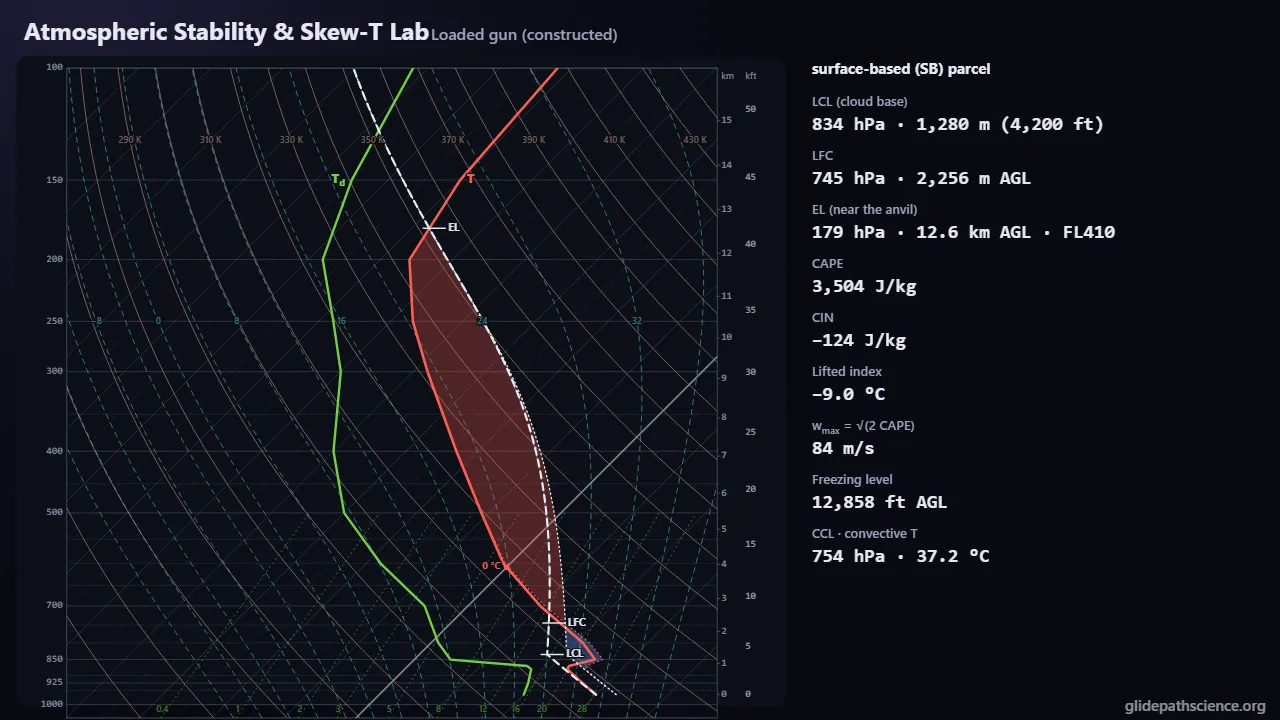
A skew-T log-P diagram built from exact thermodynamics: Bolton's vapor pressure and equivalent potential temperature, the AMS Glossary pseudo-adiabat integrated numerically, and an exact lifting condensation level. Students read the diagram's line families, lift surface, mixed-layer and most-unstable parcels, and see CIN as the lid and CAPE as the fuel, both drawn as energy areas. Eight constructed soundings (a severe-storm loaded gun, summer cumulus, a marine layer, radiation fog, freezing rain, a dry microburst, a tropical sounding and the standard atmosphere), or a pasted plain-text sounding, can be edited by dragging or typing points and heated to an afternoon high until the lid breaks. A Parcel Lab follows a pushed parcel's forces, speed and energy books to its maximum parcel level or through stable oscillations; a Sounding Reader marks inversions, lids, warm noses and inverted Vs; and a Flight Weather tab, for training only, compares the pilots' cloud-base and density-altitude rules with the exact values and flags freezing levels and possible icing. An Advanced track covers Poisson's equation, why the diagram is skewed and logarithmic, thickness, saturation, the moist lapse rate, equivalent potential temperature, virtual temperature, layer lifting, reversible ascent, buoyancy oscillations and entrainment.
What you'll learn
- Read a skew-T log-P diagram's five line families: isobars, skewed isotherms, dry adiabats, moist adiabats and mixing-ratio lines.
- Lift an air parcel along the dry and moist adiabats to find its lifting condensation level, level of free convection and equilibrium level.
- Interpret CAPE and CIN as energies per kilogram drawn as areas on the diagram, and relate them to updraft speed and the lid that holds storms back.
- Read a sounding for stability, thunderstorm potential, fog, freezing rain, dry microbursts, cloud bases, freezing levels and icing.
What you can do
- Guided walkthroughStep-by-step, in Intro and Advanced tracks.
- SandboxEvery control of the model, to explore freely.
- Virtual labA realistic experiment with measurement noise and data analysis.
- Concept checksQuestions about ideas and vocabulary, with no calculating.
- PredictionCommit to a prediction, then see the result.
- Classroom demoProjector mode and recordable clips for slides.
- Works offlineA single downloadable file, verified to run without a network.
Before you start
- Temperature, pressure and humidity, including the idea of a dewpoint
- Reading graphs with a logarithmic axis
- For the Advanced track: the ideal gas law, the first law of thermodynamics and basic calculus
Run or download
Run it in your browser
Nothing to install and no account. Works on laptops, Chromebooks, tablets, and phones.
Launch Atmospheric Stability & Skew-T LabDownload for offline use
One HTML file (934 kB) that opens in any modern browser with no network: for rooms with unreliable Wi-Fi, or to keep a copy.
Download the fileFile details and checksum
- File
skew-t-lab-v1.3.html- Version
- 1.3, released November 15, 2026
- Build
1e0778c- Size
- 956,166 bytes
- SHA-256
a91da71cc02f17a782fab341eee2f879283c900fe9d6d4bf9b215a348e68eea1- Offline
- Checked to run with all network access blocked.
The model and its limits
What the model assumes
- Hydrostatic balance and constant gravity; heights from the hypsometric equation with the environment's virtual temperature.
- Temperature and dewpoint vary linearly in the logarithm of pressure between reported levels.
- Saturation vapor pressure over liquid water (Bolton 1980), as radiosondes report dewpoints; Bolton's constants.
- Unsaturated parcels follow the dry adiabat; saturated parcels follow the AMS Glossary pseudo-adiabat (Advanced: reversible ascent, with or without condensate loading).
- Buoyancy from virtual temperature by default; CAPE and CIN integrated with crossings found by root finding, and positive layers under 1 J/kg treated as neutral.
- Heating builds a dry-adiabatic mixed layer with its water vapor mixed evenly and none added from the surface.
- Every built-in sounding is constructed from a documented archetype, not observed.
What it leaves out
- No winds or shear: thunderstorm potential is judged, not storm type.
- No advection, fronts or time evolution beyond the simple heating model.
- No ice-phase latent heat and no saturation over ice.
- Parcel theory: entrainment only as an illustrative rate, and no pressure perturbations or drag; parcel updraft speeds are upper bounds.
- No surface fluxes, radiation or terrain; radiosonde drift and sensor lag are ignored.
- Flight Weather is for training only: its rules of thumb and categories are illustrative and it is not for flight planning.
Cite this simulation
APA 7
Meier, D. (2026). Atmospheric Stability & Skew-T Lab (Version 1.3) [Computer simulation]. Glidepath Science. https://glidepathscience.org/simulations/skew-t-lab/
MLA 9
Meier, David. Atmospheric Stability & Skew-T Lab. Version 1.3, Glidepath Science, 2026, glidepathscience.org/simulations/skew-t-lab/.
AIP
D. Meier, Atmospheric Stability & Skew-T Lab, version 1.3 (Glidepath Science, 2026), https://glidepathscience.org/simulations/skew-t-lab/.
BibTeX
@misc{meier2026atmosphericstabilityskewtlab,
  author       = {Meier, David},
  title        = {{Atmospheric Stability & Skew-T Lab}},
  year         = {2026},
  publisher    = {Glidepath Science},
  version      = {1.3},
  note         = {Interactive simulation, version 1.3},
  howpublished = {\url{https://glidepathscience.org/simulations/skew-t-lab/}},
  url          = {https://glidepathscience.org/simulations/skew-t-lab/}
}
Credits and license
Created by Dr. David Meier, Glidepath Science.
Licensed under Creative Commons Attribution-NonCommercial-ShareAlike 4.0 International (CC BY-NC-SA 4.0). You may share and adapt it for noncommercial purposes, such as teaching, with credit and under the same license. Licensing and reuse
AI tools (Claude, from Anthropic, and ChatGPT, from OpenAI) were used in developing Glidepath Science and its simulations. Dr. David Meier reviewed, edited, and modified every release version.