
NewVersion 1.0
Neuron Signal Lab
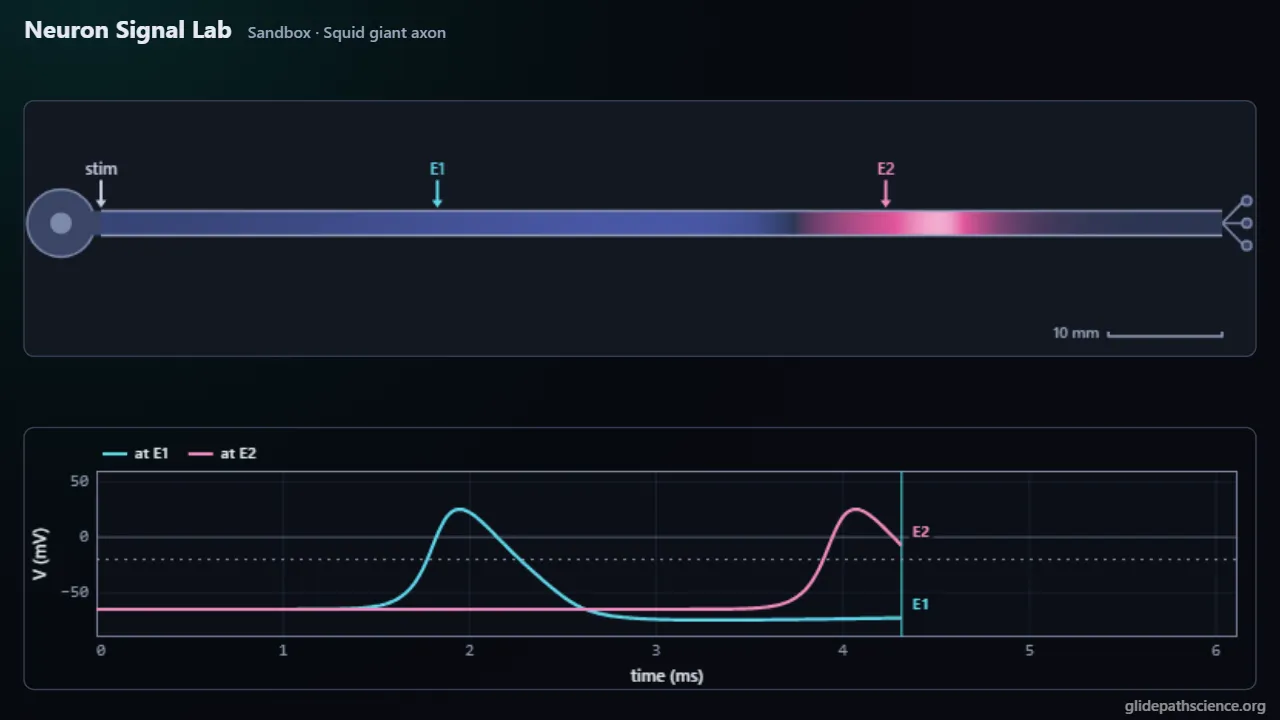
Inject current into an axon and watch a passive signal fade within a few length constants, then fire it, time the action potential between two electrodes, wrap the axon in myelin and race it.
About this simulation
Why does a nerve signal arrive at full size when a wire this poor would lose it within millimeters? Students treat the axon as a leaky cable of resistors and capacitors: one axon, passive or firing, bare or myelinated, with its diameter, membrane and stimulus to change, its ladder of resistors and capacitors drawn over it, and electrodes that time the spike. A guided walkthrough at two levels runs from the membrane as a capacitor and a resistor through the core as a poor wire, the length constant, why passive spread fails, the action potential, conduction speed and myelin; the Advanced track adds the cable equation, input resistance, Hodgkin and Huxley’s gates, how speed scales with diameter, refractoriness and demyelination. A Cable Bench measures the length constant; a Spike Lab fires one membrane patch to find its threshold and refractory period; a Myelin Race sets a bare axon against a myelinated one, then strips the myelin until the signal fails. A concept challenge with Faster or slower?, and a prediction lab with fresh numbers, round it out.
What you'll learn
- Model the cell membrane as an RC circuit: a thin lipid layer stores charge like a capacitor and leaks it through ion channels like a resistor, with τm = RmCm the same for a patch of any size.
- Explain why a steady voltage along an axon falls off as e^(−x/λ), with a length constant of a millimeter or so, so passive spread cannot carry a signal down a nerve.
- Explain how the action potential regenerates: above threshold, sodium channels open and the membrane fires, charging the patch ahead past threshold, so the signal is rebuilt at every point and arrives at full size.
- Explain how myelin, by raising the membrane’s resistance and lowering its capacitance, makes the signal jump from node to node many times faster than in a bare axon of the same size.
What you can do
- Guided walkthroughStep-by-step, in Intro and Advanced tracks.
- SandboxEvery control of the model, to explore freely.
- Virtual labA realistic experiment with measurement noise and data analysis.
- Concept checksQuestions about ideas and vocabulary, with no calculating.
- PredictionCommit to a prediction, then see the result.
- Classroom demoProjector mode and recordable clips for slides.
- Works offlineA single downloadable file, verified to run without a network.
Before you start
- Ohm’s law, the resistance of a wire, and capacitors
- Algebra and the exponential discharge of a capacitor
- For the Advanced track: partial derivatives, a linear partial differential equation, the error function, and systems of nonlinear ordinary differential equations
Run or download
Run it in your browser
Nothing to install and no account. Works on laptops, Chromebooks, tablets, and phones.
Launch Neuron Signal LabDownload for offline use
One HTML file (727 kB) that opens in any modern browser with no network: for rooms with unreliable Wi-Fi, or to keep a copy.
Download the fileFile details and checksum
- File
neuron-signal-lab-v1.0.html- Version
- 1.0, released November 15, 2026
- Build
3ff168d- Size
- 744,839 bytes
- SHA-256
ab9caa6302f5e079bc7f9ef17637c83008be5ae99eaff6233f8c04497a90fa15- Offline
- Checked to run with all network access blocked.
The model and its limits
What the model assumes
- The membrane follows Hodgkin and Huxley’s 1952 squid-axon equations, resting at −65.0 mV, with temperature multiplying every gate’s rates by 3 for each 10 °C; a passive membrane is a plain leak with the chosen Rm.
- The axon is a row of compartments, at most a tenth of a length constant apart for a firing axon, joined by the core’s resistance and solved implicitly; the squid axon’s speed comes out at 18.6 m/s, within 1 % of the same equations solved with no grid.
- Myelin is wraps of membrane in series with the axon’s own, dividing the capacitance and leak per area by 2n + 1 for n wraps; internodes are passive, and each 1 µm node carries ten times the squid’s channel density, an illustrative choice.
- Speeds are timed between two electrodes away from the ends, at the moment the voltage rises through −20 mV.
- Membrane and axoplasm values are typical ones; real membranes and axons vary widely.
What it leaves out
- Ion concentrations and the Nernst and Goldman equations are left out: the resting potential is taken as given.
- Every membrane uses the squid’s channel kinetics, so mammalian speeds at body temperature are reached only approximately, and only with myelin.
- No synapses, dendrites or cell body, no fine structure of the nodes, no channel or electrode noise, and no extracellular fields or coupling between neighboring axons.
- For learning, not for training or medical use.
Cite this simulation
APA 7
Meier, D. (2026). Neuron Signal Lab (Version 1.0) [Computer simulation]. Glidepath Science. https://glidepathscience.org/simulations/neuron-signal-lab/
MLA 9
Meier, David. Neuron Signal Lab. Version 1.0, Glidepath Science, 2026, glidepathscience.org/simulations/neuron-signal-lab/.
AIP
D. Meier, Neuron Signal Lab, version 1.0 (Glidepath Science, 2026), https://glidepathscience.org/simulations/neuron-signal-lab/.
BibTeX
@misc{meier2026neuronsignallab,
  author       = {Meier, David},
  title        = {{Neuron Signal Lab}},
  year         = {2026},
  publisher    = {Glidepath Science},
  version      = {1.0},
  note         = {Interactive simulation, version 1.0},
  howpublished = {\url{https://glidepathscience.org/simulations/neuron-signal-lab/}},
  url          = {https://glidepathscience.org/simulations/neuron-signal-lab/}
}
Credits and license
Created by Dr. David Meier, Glidepath Science.
Licensed under Creative Commons Attribution-NonCommercial-ShareAlike 4.0 International (CC BY-NC-SA 4.0). You may share and adapt it for noncommercial purposes, such as teaching, with credit and under the same license. Licensing and reuse
AI tools (Claude, from Anthropic, and ChatGPT, from OpenAI) were used in developing Glidepath Science and its simulations. Dr. David Meier reviewed, edited, and modified every release version.