
NewVersion 1.1
Spatial Disorientation: The Leans
Spin a chair and fly in cloud: the inner ear senses changes in rotation, not rotation, so a steady turn fades, a stop feels like turning back, and leveling the wings brings on the leans.
About this simulation
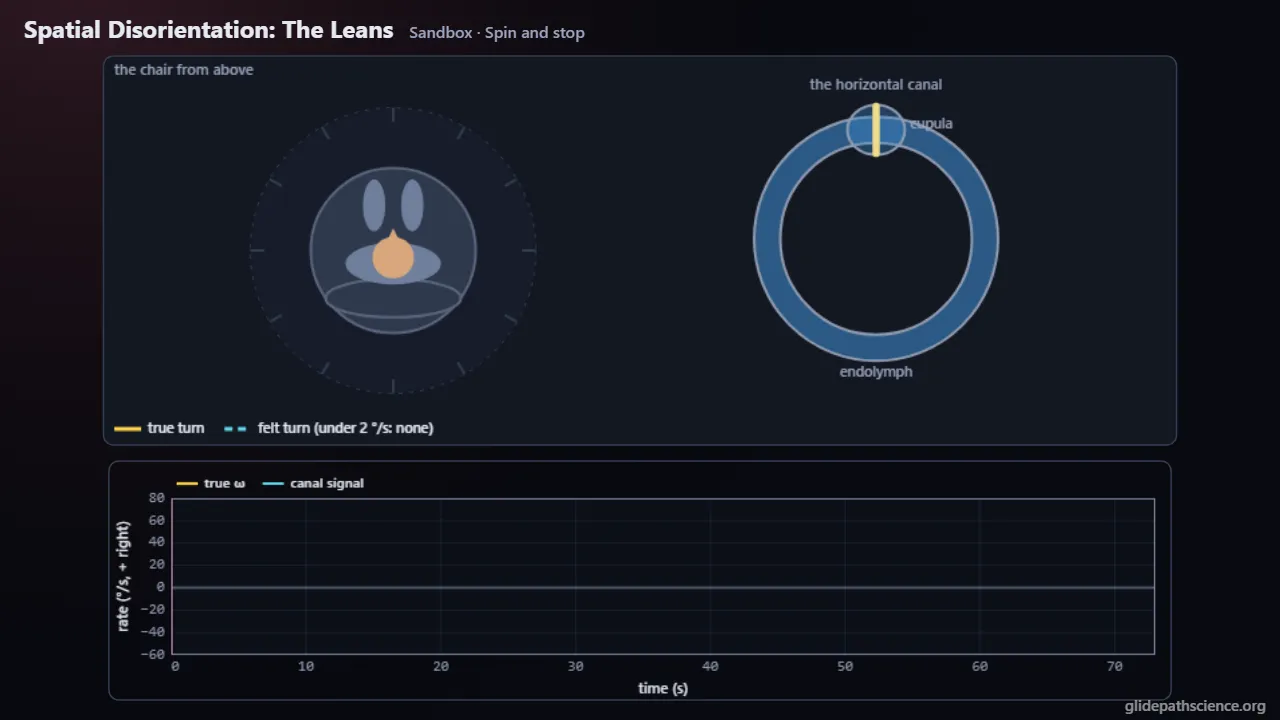
The semicircular canals sense changes in rotation, not rotation itself. Modeled as an overdamped torsion pendulum with a time constant of about 6 s, the canal’s signal fades during a steady turn, reports a turn the other way after a stop, and misses a start gentler than a threshold of about 2 °/s. A guided walkthrough at two levels builds from the fluid’s lag to the leans; the Advanced track adds the pendulum’s two time constants, its frequency response, velocity storage, the otoliths, the Coriolis illusion and the graveyard spiral. The Sandbox spins, holds, ramps and swings a rotating chair, plotting the canal’s signal and the felt rotation against the true one. In the Cockpit, students roll a small airplane slowly into a bank in cloud, level the wings and watch the pilot’s felt bank part from the attitude indicator, then fly again trusting the instruments. A Canal Model tab drives the canal with steps and sines. A concept challenge and a prediction lab round it out. For learning, not for flight training or medical use.
What you'll learn
- Explain that the canals sense changes in rotation: in a steady turn the fluid catches up and the signal fades with a time constant of about 6 s, so after half a minute a steady turn feels like none.
- Explain why stopping after a long spin feels like turning the other way, and why the after-effect lasts until it fades under a threshold of about 2 °/s.
- Explain the leans: a slow roll into a bank is never felt, leveling the wings is, so the pilot feels banked the other way and leans to fix it.
- Explain why in cloud no sense tells the pilot the truth about bank, but the attitude indicator does, and why pilots learn to believe it over every feeling.
What you can do
- Guided walkthroughStep-by-step, in Intro and Advanced tracks.
- SandboxEvery control of the model, to explore freely.
- Concept checksQuestions about ideas and vocabulary, with no calculating.
- PredictionCommit to a prediction, then see the result.
- Classroom demoProjector mode and recordable clips for slides.
- Works offlineA single downloadable file, verified to run without a network.
Before you start
- Angular velocity and angular acceleration
- Exponential decay and time constants
- For the Advanced track: damped oscillators, differential equations and frequency response
Run or download
Run it in your browser
Nothing to install and no account. Works on laptops, Chromebooks, tablets, and phones.
Launch Spatial Disorientation: The LeansDownload for offline use
One HTML file (683 kB) that opens in any modern browser with no network: for rooms with unreliable Wi-Fi, or to keep a copy.
Download the fileFile details and checksum
- File
spatial-disorientation-leans-v1.1.html- Version
- 1.1, released November 15, 2026
- Build
68e53b8- Size
- 699,616 bytes
- SHA-256
16388a6959f2391b9938b63f69e844d7f9640107d59b66bd57e0320ef51fe607- Offline
- Checked to run with all network access blocked.
The model and its limits
What the model assumes
- Each canal is Steinhausen’s torsion pendulum, with time constants of 5 ms and 6.0 s, solved in closed form on a 0.01 s grid, exact for the sim’s piecewise-linear profiles.
- A felt rate under 2 °/s is felt as nothing; in Advanced, velocity storage, a leaky integrator with a 16 s time constant, stretches the felt yaw rate.
- A nod during a spin shares the rotation among canals along the head’s axes, which produces the Coriolis illusion.
- The airplane flies level, coordinated turns along prescribed bank histories; the felt bank follows the felt roll rate and drifts back toward the otoliths’ “level” with a 20 s time constant.
- The physiological constants are typical or illustrative values; real canals and people vary, but the shapes and the ideas do not depend on the exact numbers.
What it leaves out
- No otolith dynamics or somatogravic illusion, no vision or conflict between what is seen and felt, and motion sickness and nystagmus only mentioned.
- No adaptation over minutes and no velocity storage in pitch and roll; each axis has one canal, untilted and unpaired.
- No uncoordinated flight, turbulence or airplane dynamics; individual variation, attention, age, alcohol and fatigue are left out.
- For learning, not for flight training or medical use.
Cite this simulation
APA 7
Meier, D. (2026). Spatial Disorientation: The Leans (Version 1.1) [Computer simulation]. Glidepath Science. https://glidepathscience.org/simulations/spatial-disorientation-leans/
MLA 9
Meier, David. Spatial Disorientation: The Leans. Version 1.1, Glidepath Science, 2026, glidepathscience.org/simulations/spatial-disorientation-leans/.
AIP
D. Meier, Spatial Disorientation: The Leans, version 1.1 (Glidepath Science, 2026), https://glidepathscience.org/simulations/spatial-disorientation-leans/.
BibTeX
@misc{meier2026spatialdisorientationtheleans,
  author       = {Meier, David},
  title        = {{Spatial Disorientation: The Leans}},
  year         = {2026},
  publisher    = {Glidepath Science},
  version      = {1.1},
  note         = {Interactive simulation, version 1.1},
  howpublished = {\url{https://glidepathscience.org/simulations/spatial-disorientation-leans/}},
  url          = {https://glidepathscience.org/simulations/spatial-disorientation-leans/}
}
Credits and license
Created by Dr. David Meier, Glidepath Science.
Licensed under Creative Commons Attribution-NonCommercial-ShareAlike 4.0 International (CC BY-NC-SA 4.0). You may share and adapt it for noncommercial purposes, such as teaching, with credit and under the same license. Licensing and reuse
AI tools (Claude, from Anthropic, and ChatGPT, from OpenAI) were used in developing Glidepath Science and its simulations. Dr. David Meier reviewed, edited, and modified every release version.