
NewVersion 1.8
Simple Harmonic Motion & Pendulums
Springs and pendulums keep time: read the period, see SHM as the shadow of circular motion, damp it, drive it to resonance, time a wide-swinging pendulum, and fit noisy sensor data.
About this simulation
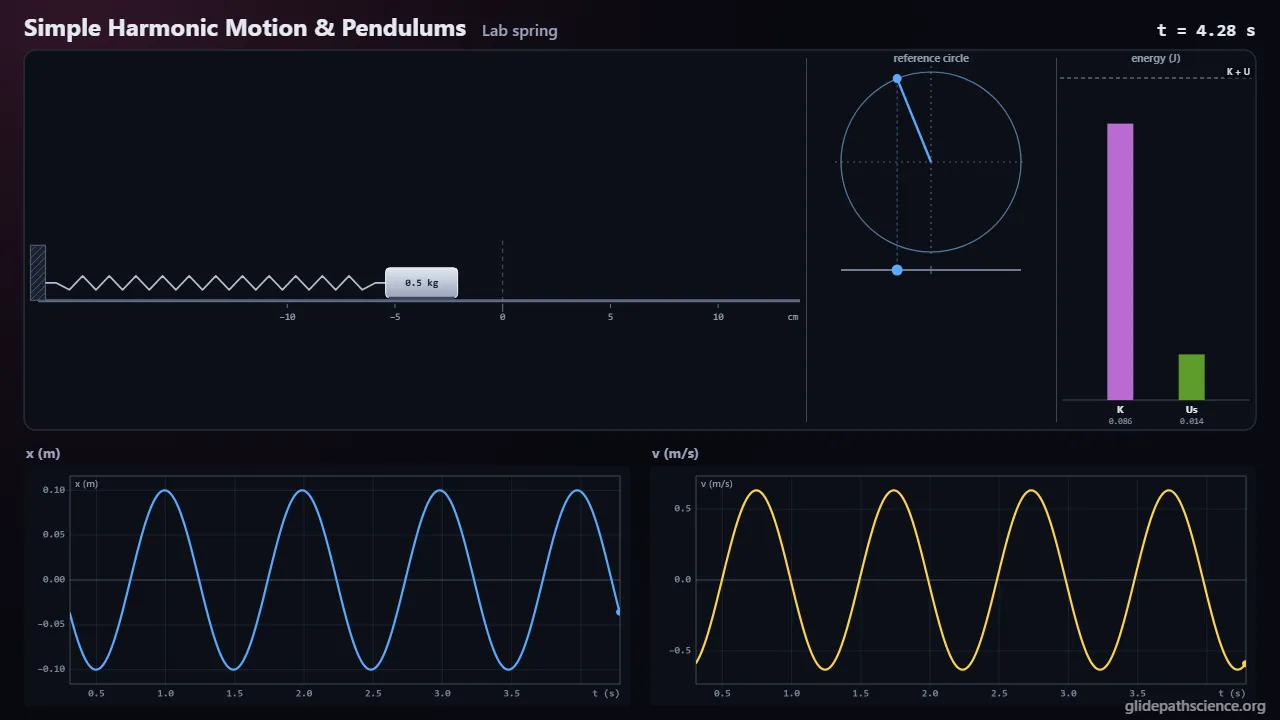
An interactive lab for oscillations. Students release springs and pendulums drawn to scale, read the period off live traces, and watch the motion as the shadow of a point on the reference circle, with energy bars that slosh between kinetic and potential energy. They add viscous, quadratic or dry-friction damping and see the amplitude die while the rhythm holds, then drive the oscillator and tune it to resonance, where the swing grows to Q times the static stretch and lags the push by a quarter cycle. Wide swings show why a pendulum is only nearly a clock: the exact period comes from the arithmetic–geometric mean. A photogate Pendulum Lab finds g from T² against L, a Resonance Lab builds the response curve and measures Q two ways, and Data Fit asks students to fit a damped cosine to noisy motion-sensor records, reading the residuals to spot dry friction and nonlinear swings. A walkthrough at two levels, concept questions and prediction rounds with fresh numbers round it out.
What you'll learn
- Calculate the period of a mass on a spring and of a pendulum, and explain why the period does not depend on the amplitude until a pendulum swings wide.
- Describe simple harmonic motion as the shadow of uniform circular motion, and relate position, velocity, acceleration and energy at any point in the cycle.
- Explain how damping reduces the amplitude by the same fraction each cycle, distinguish underdamped, critically damped and overdamped motion, and find Q from a ring-down.
- Predict the steady amplitude and phase lag of a driven oscillator, identify resonance, and measure Q from the width of a resonance curve.
What you can do
- Guided walkthroughStep-by-step, in Intro and Advanced tracks.
- SandboxEvery control of the model, to explore freely.
- Virtual labA realistic experiment with measurement noise and data analysis.
- Concept checksQuestions about ideas and vocabulary, with no calculating.
- PredictionCommit to a prediction, then see the result.
- Classroom demoProjector mode and recordable clips for slides.
- Works offlineA single downloadable file, verified to run without a network.
Before you start
- Newton’s second law
- Hooke’s law for springs
- kinetic and potential energy
- radians, sine and cosine
- reading graphs of motion against time
Run or download
Run it in your browser
Nothing to install and no account. Works on laptops, Chromebooks, tablets, and phones.
Launch Simple Harmonic Motion & PendulumsDownload for offline use
One HTML file (851 kB) that opens in any modern browser with no network: for rooms with unreliable Wi-Fi, or to keep a copy.
Download the fileFile details and checksum
- File
simple-harmonic-motion-v1.8.html- Version
- 1.8, released November 15, 2026
- Build
ea36564- Size
- 871,491 bytes
- SHA-256
4dccf1b15eea937ce273224e9128e69ec3af902c7dbcedfd2423348c2e13e8dd- Offline
- Checked to run with all network access blocked.
The model and its limits
What the model assumes
- Linear springs obeying F = −kx; a spring’s own mass is included as m_s/3 (Rayleigh’s method).
- A pendulum is a point bob on a light rigid rod, or a uniform rod with an optional bob, swinging in a plane; the exact pendulum uses sin θ, the small-angle model uses θ.
- Damping is viscous (−bv), quadratic air drag (−cv|v|) or Coulomb dry friction (μs, μk from the library’s surface table), applied to the moving mass.
- The drive is an ideal sinusoidal force on a spring’s mass or torque at a pendulum’s pivot, unaffected by the motion.
- Linear cases are solved in closed form; nonlinear cases are integrated with fourth-order Runge–Kutta at no more than 1/400 of a period, with dry-friction turnarounds located exactly.
- Lab data come from a simulated sensor with Gaussian noise, millimeter rounding and a fixed sampling rate; fit uncertainties are fit standard errors from the least-squares covariance.
What it leaves out
- No rod or string mass or stretch except in the physical pendulum; a string going slack is flagged, not modeled.
- No air buoyancy or added mass (about one part in 10,000 of the period for a metal bob), and no pivot friction beyond the damping knob.
- No surge waves along a spring, no spring nonlinearity and no coil binding.
- Motion is planar: no spherical pendulums and no Earth rotation (Foucault).
- No thermal expansion of a clock rod in the simulated motion, and no escapement.
- The drive does not respond to the load it drives.
- Long chaotic runs depend on the step size and on rounding, although their statistics do not.
Cite this simulation
APA 7
Meier, D. (2026). Simple Harmonic Motion & Pendulums (Version 1.8) [Computer simulation]. Glidepath Science. https://glidepathscience.org/simulations/simple-harmonic-motion/
MLA 9
Meier, David. Simple Harmonic Motion & Pendulums. Version 1.8, Glidepath Science, 2026, glidepathscience.org/simulations/simple-harmonic-motion/.
AIP
D. Meier, Simple Harmonic Motion & Pendulums, version 1.8 (Glidepath Science, 2026), https://glidepathscience.org/simulations/simple-harmonic-motion/.
BibTeX
@misc{meier2026simpleharmonicmotionpendulums,
  author       = {Meier, David},
  title        = {{Simple Harmonic Motion & Pendulums}},
  year         = {2026},
  publisher    = {Glidepath Science},
  version      = {1.8},
  note         = {Interactive simulation, version 1.8},
  howpublished = {\url{https://glidepathscience.org/simulations/simple-harmonic-motion/}},
  url          = {https://glidepathscience.org/simulations/simple-harmonic-motion/}
}
Credits and license
Created by Dr. David Meier, Glidepath Science.
Licensed under Creative Commons Attribution-NonCommercial-ShareAlike 4.0 International (CC BY-NC-SA 4.0). You may share and adapt it for noncommercial purposes, such as teaching, with credit and under the same license. Licensing and reuse
AI tools (Claude, from Anthropic, and ChatGPT, from OpenAI) were used in developing Glidepath Science and its simulations. Dr. David Meier reviewed, edited, and modified every release version.