
NewVersion 1.3
Newton's Laws & Free-Body Diagrams
Push a crate, lift a bucket and jump on a force plate: name every force by its interaction, watch static friction match a push until it slips, and find the partner of every force.
About this simulation
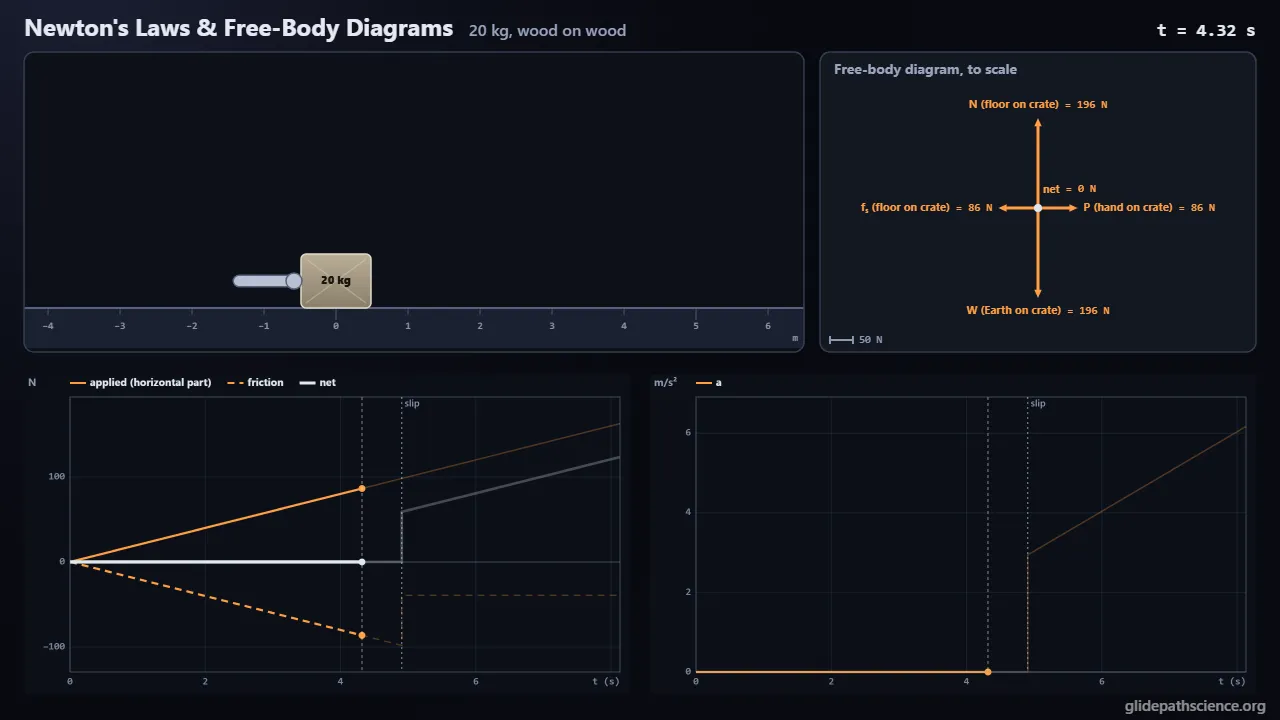
Forces don't keep things moving; they change the motion. Students push a crate across a level floor and watch static friction keep pace with a rising push until the crate slips and friction drops; lift a bucket on a rope; and turn a force-plate record into a takeoff speed. Every force is drawn to scale on a live free-body diagram and labeled by type and agent, such as "N (floor on crate)". An Intro walkthrough covers forces as interactions, mass and weight, the first and second laws, the normal force, static and kinetic friction, angled pulls and third-law pairs; an Advanced track treats the laws as constraint problems: friction as an inequality, hysteresis, lift-off, contact with friction, indeterminate contact, impulse, momentum, open systems and where the laws stop applying. A Diagram Builder checks students' own free-body diagrams, and a Third-Law Lab sets blocks in contact, a horse and cart, a tug of war and two skaters side by side, one interaction and two bodies at a time. Every answer comes from an exact engine with no step size.
What you'll learn
- Identify every force on a body as an interaction with a named agent, and draw its free-body diagram with correct directions and relative sizes.
- Apply ΣF = ma on each axis to find accelerations, normal forces and tensions, recognizing that the net force sets the acceleration, not the velocity.
- Explain why static friction matches the applied force up to μsN, predict when a crate slips, and use kinetic friction μkN once it slides.
- Identify third-law pairs as equal and opposite forces on two different bodies, and use them to find contact forces and the momentum of bodies that push apart.
What you can do
- Guided walkthroughStep-by-step, in Intro and Advanced tracks.
- SandboxEvery control of the model, to explore freely.
- Virtual labA realistic experiment with measurement noise and data analysis.
- Concept checksQuestions about ideas and vocabulary, with no calculating.
- PredictionCommit to a prediction, then see the result.
- Classroom demoProjector mode and recordable clips for slides.
- Works offlineA single downloadable file, verified to run without a network.
Before you start
- Velocity and acceleration in one dimension
- Vectors and their horizontal and vertical components
- Basic algebra and right-triangle trigonometry
Run or download
Run it in your browser
Nothing to install and no account. Works on laptops, Chromebooks, tablets, and phones.
Launch Newton's Laws & Free-Body DiagramsDownload for offline use
One HTML file (852 kB) that opens in any modern browser with no network: for rooms with unreliable Wi-Fi, or to keep a copy.
Download the fileFile details and checksum
- File
newtons-laws-v1.3.html- Version
- 1.3, released November 15, 2026
- Build
821a5ca- Size
- 872,355 bytes
- SHA-256
be90b7daf76937567281a7ace6277e07b8a38d282831b12ad251d934653c0c9c- Offline
- Checked to run with all network access blocked.
The model and its limits
What the model assumes
- Bodies are particles: they slide but never tip or rotate.
- Amontons–Coulomb friction with coefficients from the library's shared surface table: static friction up to μsN, kinetic friction μkN independent of speed, and an instant drop at the slip.
- Every force input is piecewise linear in time and solved exactly in closed form, with events (slip, stop, lift-off, landing) found as polynomial roots.
- The floor is an inertial frame; ropes are massless and do not stretch.
- Two blocks in contact move as one body; at rest with friction the model reports the band of possible contact forces.
- The force-plate jump is a stylized piecewise-linear countermovement profile; the jumper is a single point.
What it leaves out
- No tipping or torque, no air drag, and rolling resistance only for the cart in the horse-and-cart scene.
- Friction does not depend on speed or contact time, so there is no stick–slip and the drop at the slip is instant.
- Motion after a crate leaves the floor is not modeled: the run stops at lift-off.
- The Earth's recoil and the floor's give are left out, and the Earth's rotation is ignored.
- Ramps, strings between blocks, pulleys, elevators and apparent weight are covered by other simulations in the library.
- Friction coefficients are approximate values typical of introductory physics tables; rubber on wet concrete, the road surfaces, the cart's rolling resistance, the jump profile and the sensor noise are illustrative.
Cite this simulation
APA 7
Meier, D. (2026). Newton's Laws & Free-Body Diagrams (Version 1.3) [Computer simulation]. Glidepath Science. https://glidepathscience.org/simulations/newtons-laws/
MLA 9
Meier, David. Newton's Laws & Free-Body Diagrams. Version 1.3, Glidepath Science, 2026, glidepathscience.org/simulations/newtons-laws/.
AIP
D. Meier, Newton's Laws & Free-Body Diagrams, version 1.3 (Glidepath Science, 2026), https://glidepathscience.org/simulations/newtons-laws/.
BibTeX
@misc{meier2026newtonslawsfreebodydiagrams,
  author       = {Meier, David},
  title        = {{Newton's Laws & Free-Body Diagrams}},
  year         = {2026},
  publisher    = {Glidepath Science},
  version      = {1.3},
  note         = {Interactive simulation, version 1.3},
  howpublished = {\url{https://glidepathscience.org/simulations/newtons-laws/}},
  url          = {https://glidepathscience.org/simulations/newtons-laws/}
}
Credits and license
Created by Dr. David Meier, Glidepath Science.
Licensed under Creative Commons Attribution-NonCommercial-ShareAlike 4.0 International (CC BY-NC-SA 4.0). You may share and adapt it for noncommercial purposes, such as teaching, with credit and under the same license. Licensing and reuse
AI tools (Claude, from Anthropic, and ChatGPT, from OpenAI) were used in developing Glidepath Science and its simulations. Dr. David Meier reviewed, edited, and modified every release version.