
NewVersion 1.0
Batteries & Electrochemistry
Build galvanic cells from metals and solutions, follow the voltage through the Nernst equation as a cell runs down, light an LED with lemons, and find where a battery’s energy really comes from.
About this simulation
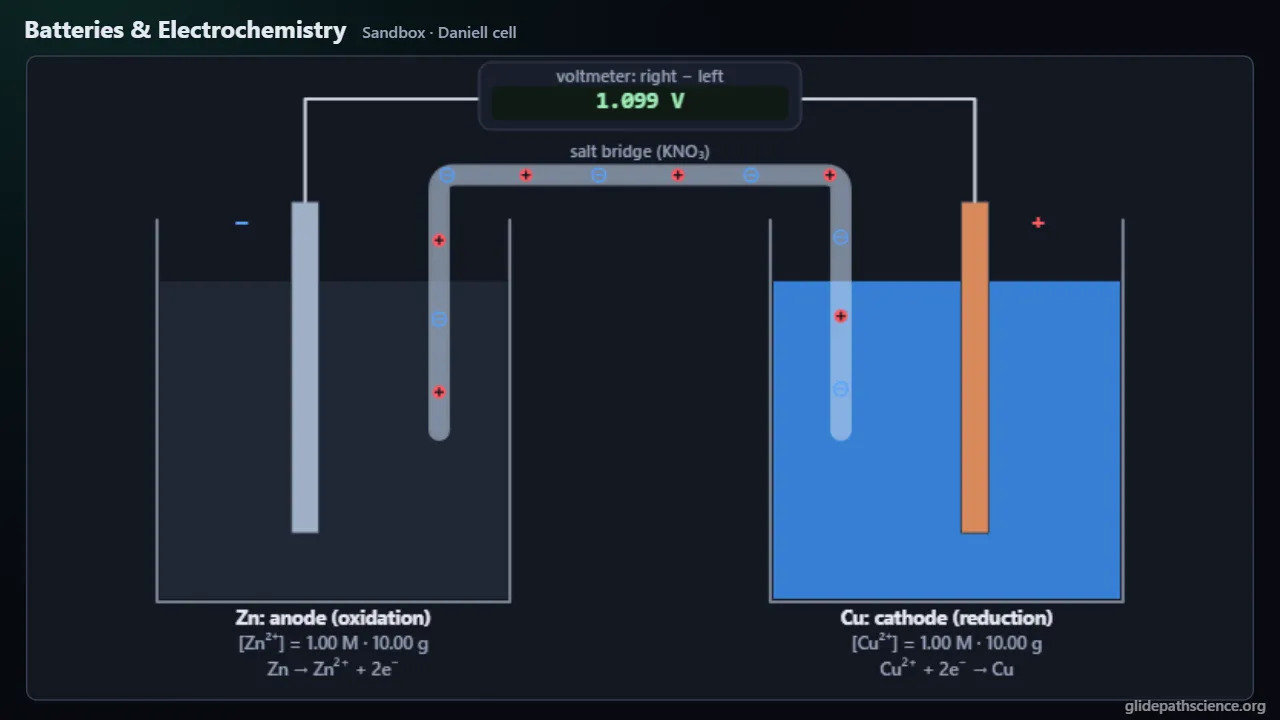
What does a battery do? Students build a galvanic cell from two of ten metals and their solutions, at any concentration and temperature, with a removable salt bridge and a voltmeter, a load or a charger, then run it down or recharge it and watch Q, the voltage, the current and the electrodes’ masses. A guided walkthrough at two levels follows redox in a beaker, half-cells and the salt bridge, anode and cathode, cell notation, standard potentials, ΔG° and K, the Nernst equation, the dead battery, the lemon and recharging; the Advanced track adds concentration cells, ΔS° from dE/dT, activities, a cell under load, overpotential, real chemistries and Faraday’s law. A Nernst Explorer plots E against log Q for six cells; a Lemon Lab wires lemons and potatoes in series and parallel to an LED and shows that the zinc, not the lemon, is the fuel; a Battery Shop discharges and recharges alkaline, NiMH, lead–acid and lithium-ion cells. A concept challenge and a prediction lab, with How many lemons? and When does it die?, round it out.
What you'll learn
- Build a galvanic cell with oxidation at the anode and reduction at the cathode, electrons through the wire and ions through the salt bridge, and find E°cell = E°cathode − E°anode from a table of standard potentials.
- Relate a cell’s voltage to free energy and equilibrium, ΔG° = −nFE° and E° = (RT/nF) ln K, and explain why a cell of about a volt has an enormous equilibrium constant.
- Use the Nernst equation, E = E° − (RT/nF) ln Q, to explain why a cell’s voltage falls as it runs and why it dies when Q reaches K.
- Explain that a battery’s voltage is set by its chemistry and its capacity by the amount of reactant, that internal resistance limits the current, and that recharging is electrolysis, governed by Faraday’s law.
What you can do
- Guided walkthroughStep-by-step, in Intro and Advanced tracks.
- SandboxEvery control of the model, to explore freely.
- Virtual labA realistic experiment with measurement noise and data analysis.
- Concept checksQuestions about ideas and vocabulary, with no calculating.
- PredictionCommit to a prediction, then see the result.
- Classroom demoProjector mode and recordable clips for slides.
- Works offlineA single downloadable file, verified to run without a network.
Before you start
- Oxidation states and balancing redox reactions
- Equilibrium constants, powers of ten, and base-10 and natural logarithms
- For the Advanced track: Gibbs free energy and entropy, and the idea of a derivative
Run or download
Run it in your browser
Nothing to install and no account. Works on laptops, Chromebooks, tablets, and phones.
Launch Batteries & ElectrochemistryDownload for offline use
One HTML file (742 kB) that opens in any modern browser with no network: for rooms with unreliable Wi-Fi, or to keep a copy.
Download the fileFile details and checksum
- File
batteries-electrochemistry-v1.0.html- Version
- 1.0, released November 15, 2026
- Build
4b8ce3d- Size
- 760,168 bytes
- SHA-256
fdc4006ca68672dd7e78147d5ba35f95613c8eb982a62248b8ae2d191dfe0a69- Offline
- Checked to run with all network access blocked.
The model and its limits
What the model assumes
- Standard reduction potentials come from OpenStax Chemistry 2e, Appendix L, with the Faraday and gas constants at their exact SI values.
- Ideal solutions: activities are concentrations against a 1 M standard, the hydrogen electrode is at 1 bar, and junction potentials are zero; the Advanced track shows Debye–Hückel activity coefficients, which hold only below about 0.01 M ionic strength.
- Each couple’s E° changes linearly with temperature, by ΔS°/(nF) from standard entropies, taken as constant over 0–80 °C.
- A running cell’s current is its EMF, less any charger’s voltage, over the total resistance, and the charge it carries moves ions and metal by Faraday’s law until equilibrium, a used-up electrode or a balanced charger ends the run.
- Lemon and potato cells use typical, illustrative voltages and internal resistances; the Battery Shop’s cells are models with typical parameters, not any manufacturer’s data, charged at constant current.
What it leaves out
- No activity coefficients in the Sandbox, ion pairing, concentrated-solution effects or liquid-junction potentials.
- No kinetics: overpotential (apart from one Advanced step), mass transport and diffusion layers are left out, so a real cell under load sags more than Ir.
- No side reactions such as zinc corroding, hydrogen evolving or water splitting on overcharge, and no oxide films on aluminum and magnesium, whose real potentials in a cell are less negative than the table’s.
- No self-discharge, aging, temperature effects on capacity or constant-voltage charging; corrosion and fuel cells are left for a later sim.
- Real cells, lithium-ion above all, can overheat or vent if shorted, crushed or overcharged; never open a battery.
Cite this simulation
APA 7
Meier, D. (2026). Batteries & Electrochemistry (Version 1.0) [Computer simulation]. Glidepath Science. https://glidepathscience.org/simulations/batteries-electrochemistry/
MLA 9
Meier, David. Batteries & Electrochemistry. Version 1.0, Glidepath Science, 2026, glidepathscience.org/simulations/batteries-electrochemistry/.
AIP
D. Meier, Batteries & Electrochemistry, version 1.0 (Glidepath Science, 2026), https://glidepathscience.org/simulations/batteries-electrochemistry/.
BibTeX
@misc{meier2026batterieselectrochemistry,
  author       = {Meier, David},
  title        = {{Batteries & Electrochemistry}},
  year         = {2026},
  publisher    = {Glidepath Science},
  version      = {1.0},
  note         = {Interactive simulation, version 1.0},
  howpublished = {\url{https://glidepathscience.org/simulations/batteries-electrochemistry/}},
  url          = {https://glidepathscience.org/simulations/batteries-electrochemistry/}
}
Credits and license
Created by Dr. David Meier, Glidepath Science.
Based on: OpenStax, Chemistry 2e, by Paul Flowers, Klaus Theopold, Richard Langley and William R. Robinson: Chapter 17, “Electrochemistry” (§17.1 Review of Redox Chemistry, §17.2 Galvanic Cells, §17.3 Electrode and Cell Potentials, §17.4 Potential, Free Energy, and Equilibrium, §17.5 Batteries and Fuel Cells and §17.7 Electrolysis) and Appendix L, “Standard Electrode (Half-Cell) Potentials”, an open textbook licensed CC BY-NC-SA 4.0 (openstax.org). The Intro track follows the chapter’s order of topics and its notation, and every standard potential is Appendix L’s; the wording, numbers, worked examples, figures and simulations are the sim’s own. No endorsement by OpenStax or the authors is implied.
Licensed under Creative Commons Attribution-NonCommercial-ShareAlike 4.0 International (CC BY-NC-SA 4.0). You may share and adapt it for noncommercial purposes, such as teaching, with credit and under the same license. Licensing and reuse
AI tools (Claude, from Anthropic, and ChatGPT, from OpenAI) were used in developing Glidepath Science and its simulations. Dr. David Meier reviewed, edited, and modified every release version.