
NewVersion 1.1
G-Force & G-LOC Centrifuge
Spin a pilot in a centrifuge or fly a tight turn: the G from bank, speed, and radius; the blood pressure left at eye level; gray-out, blackout, and G-LOC in order; and what a G-suit, straining, and a reclined seat add.
About this simulation
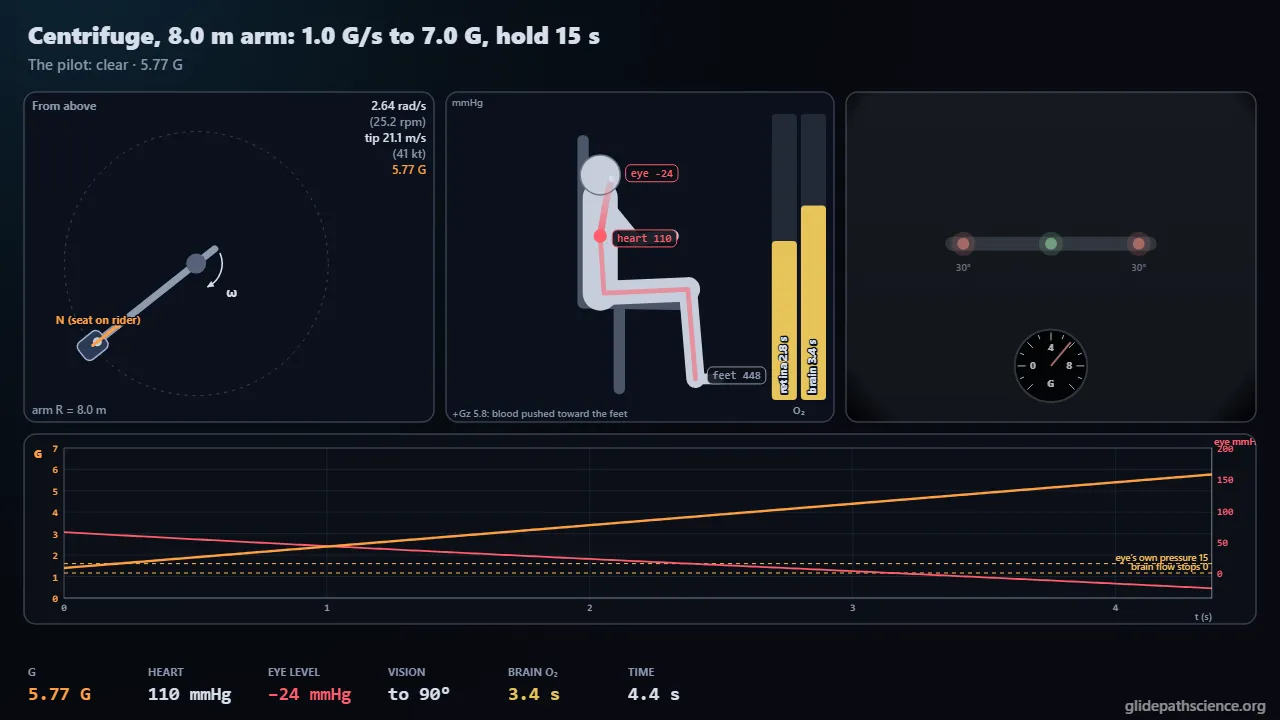
G as a load on the body, in the ground frame: the seat pushes the pilot in, and nothing pushes out. A level turn’s load factor comes from its bank (n = 1/cos φ), a centrifuge’s from its spin and arm, and the heart must then hold up a blood column as if it weighed n times as much, so eye-level pressure falls about 23 mmHg (3.1 kPa) per G. A stated model (a rigid column, a two-speed reflex, and 5 s oxygen stores in 18 rings of retina and in the brain) plays out gray-out, blackout, and G-LOC in order: a slow pull gives warning, and a rapid pull can bring G-LOC about 5 s after the flow stops with almost none. The Sandbox flies a centrifuge or an aircraft (level turns, loops, fixed radii, manual pulls, and an optional stall limit) with the pilot’s column, gauges, oxygen stores, and closing view, and an optional heartbeat, breathing, and motor sound. The Centrifuge Profile tab rides standard profiles over the model’s G-time tolerance curves, straining by hand, and surveys ten seeded subjects to show why no single limit fits everyone; the Pilot’s Body tab builds the steady pressure budget. Activities: which way the seat pushes in six scenes, what a pilot will see on eight rides, the cheapest protection plan that meets a maneuver’s standard, and a mystery pilot measured with pressure probes and a fit. An Advanced track covers ∇P = ρ(g − a), centrifuge onset and short arms, the flight envelope, feedback, the G-time curve, breath timing, pressure breathing, push–pull, and incapacitation. Teaching material, not medical guidance.
What you'll learn
- Explain G as the seat’s push divided by the weight, toward the center of a turn and up, and find it from a bank angle (n = 1/cos φ) or a centrifuge’s spin and arm.
- Calculate the blood column’s pressure drop, ρgnh, and the eye-level pressure, and explain why vision fails before consciousness.
- Explain how the reflex and the brain’s few seconds of stored oxygen make onset rate matter: warning in a slow pull, little or none in a rapid one.
- Compare what a G-suit, the straining maneuver, pressure breathing, and a reclined seat each add, in pressure at the heart or a shorter column.
What you can do
- Guided walkthroughStep-by-step, in Intro and Advanced tracks.
- SandboxEvery control of the model, to explore freely.
- Virtual labA realistic experiment with measurement noise and data analysis.
- Concept checksQuestions about ideas and vocabulary, with no calculating.
- PredictionCommit to a prediction, then see the result.
- Classroom demoProjector mode and recordable clips for slides.
- Works offlineA single downloadable file, verified to run without a network.
Before you start
- Newton’s second law and circular motion (centripetal acceleration v²/r and ω²r)
- Pressure in a fluid column, P = ρgh
- For the Advanced track: vectors, derivatives, and a first look at feedback and rates
Run or download
Run it in your browser
Nothing to install and no account. Works on laptops, Chromebooks, tablets, and phones.
Launch G-Force & G-LOC CentrifugeDownload for offline use
One HTML file (877 kB) that opens in any modern browser with no network: for rooms with unreliable Wi-Fi, or to keep a copy.
Download the fileFile details and checksum
- File
g-loc-centrifuge-v1.1.html- Version
- 1.1, released November 15, 2026
- Build
5b3a156- Size
- 897,587 bytes
- SHA-256
937007de8385426fd7ad50020e4a35c77fc05c9761b101349bed48e4b84531d8- Offline
- Checked to run with all network access blocked.
The model and its limits
What the model assumes
- Ground frame: the seat’s push supplies the turn’s acceleration and holds the weight up; no centrifugal force is drawn.
- A rigid blood column: eye-level pressure is heart-level pressure minus ρgnh cos α, with ρ = 1060 kg/m³ and h = 0.30 m (approx.).
- The reflex is one lag with two speeds (5 s rising, 1.5 s falling), gain 0.5, limited to −25 to +30 mmHg (approx.).
- The retina (18 rings) and the brain each hold 5 s of oxygen at zero flow; a store drains below half of normal flow and refills over about 8 s.
- Protections are inputs with stated effects: the suit 8 mmHg per G above 2 G, the strain and tensing by quality, and pressure breathing 12 mmHg per G from 4 G.
- Calibrated to the classic relaxed values: gray-out 4.1, blackout 4.7, and G-LOC 5.4 G at 0.1 G/s; G-LOC about 5.5 s into a rapid pull.
What it leaves out
- No cardiac output, flow resistance, or elastic vessels; the reflex is a single lag, not separate heart-rate and vascular branches.
- Fixed intraocular pressure; the retina’s rings and the brain’s single store are illustrative.
- No fatigue, dehydration, heat, or illness, which lower real tolerance; −Gz beyond the pressure rise, +Gx, and ±Gy limits are not modeled.
- No flight dynamics; the loop is flown at constant speed and radius; a centrifuge run uses the G at the heart.
- Recovery times after G-LOC are literature averages, and the survey’s spreads are illustrative; calibrated only to about 9 G.
- For learning only: real G tolerance varies from person to person and day to day; not medical advice or a substitute for physiological training.
Cite this simulation
APA 7
Meier, D. (2026). G-Force & G-LOC Centrifuge (Version 1.1) [Computer simulation]. Glidepath Science. https://glidepathscience.org/simulations/g-loc-centrifuge/
MLA 9
Meier, David. G-Force & G-LOC Centrifuge. Version 1.1, Glidepath Science, 2026, glidepathscience.org/simulations/g-loc-centrifuge/.
AIP
D. Meier, G-Force & G-LOC Centrifuge, version 1.1 (Glidepath Science, 2026), https://glidepathscience.org/simulations/g-loc-centrifuge/.
BibTeX
@misc{meier2026gforcegloccentrifuge,
  author       = {Meier, David},
  title        = {{G-Force & G-LOC Centrifuge}},
  year         = {2026},
  publisher    = {Glidepath Science},
  version      = {1.1},
  note         = {Interactive simulation, version 1.1},
  howpublished = {\url{https://glidepathscience.org/simulations/g-loc-centrifuge/}},
  url          = {https://glidepathscience.org/simulations/g-loc-centrifuge/}
}
Credits and license
Created by Dr. David Meier, Glidepath Science.
Licensed under Creative Commons Attribution-NonCommercial-ShareAlike 4.0 International (CC BY-NC-SA 4.0). You may share and adapt it for noncommercial purposes, such as teaching, with credit and under the same license. Licensing and reuse
AI tools (Claude, from Anthropic, and ChatGPT, from OpenAI) were used in developing Glidepath Science and its simulations. Dr. David Meier reviewed, edited, and modified every release version.