
NewVersion 1.0
Reaction Rates & Arrhenius
Watch molecules collide in a box and react only when they hit hard enough and the right way round, then find a rate law from initial rates and the activation energy from an Arrhenius plot.
About this simulation
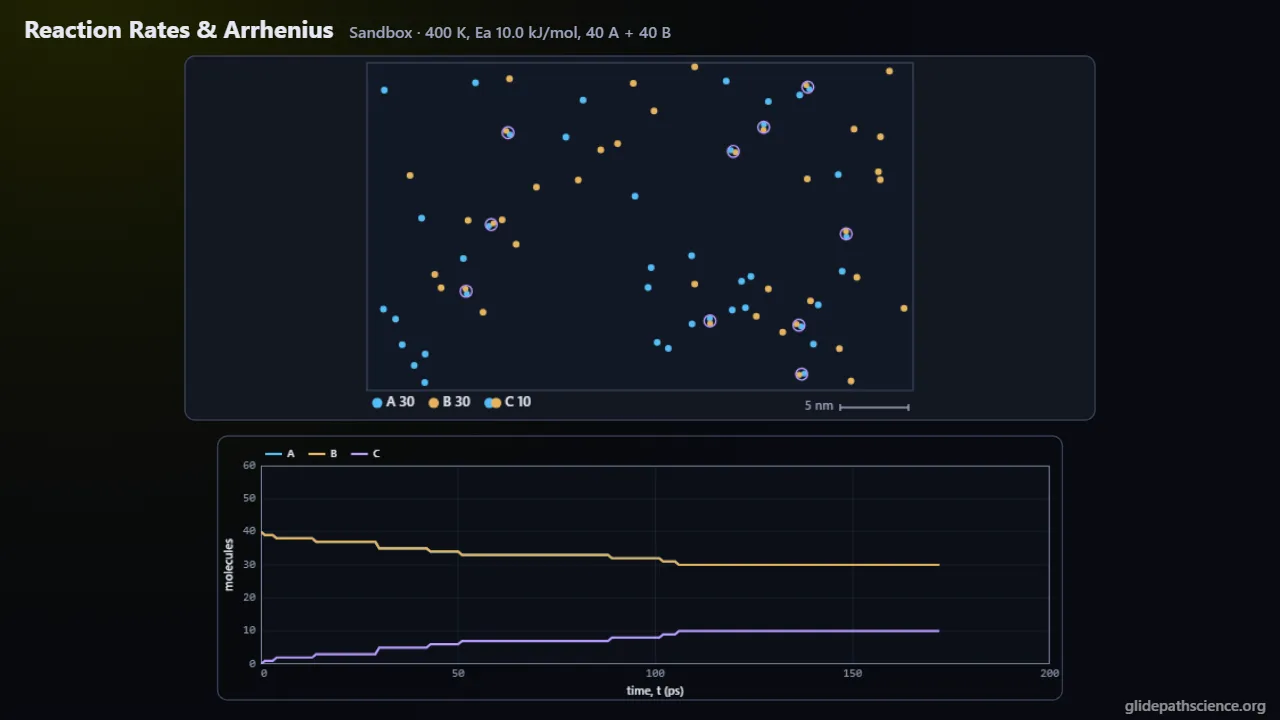
Why does a reaction speed up so much when it warms by a few degrees? Students watch a box of molecules collide, set the temperature, the numbers of A and B, the barrier, how picky the orientation is and a catalyst, count the collisions with energy to spare, and log runs for their own Arrhenius plot. A guided walkthrough at two levels runs from what a rate is through collisions, activation energy, orientation, concentration, initial rates and the rate law, temperature, the fraction above Eₐ, the Arrhenius plot and catalysts; the Advanced track adds integrated rate laws and half-lives, collision theory, the fit’s uncertainty, the Eyring equation and mechanisms. An Energy Diagram draws reactants, the transition state and products, and a catalyzed path; a Rate Law Lab applies the method of initial rates to four reactions and a mystery; an Arrhenius Plot fits ln k against 1/T for Eₐ and its uncertainty and, in Advanced, the Eyring plot for ΔH‡ and ΔS‡. A concept challenge and a prediction lab with fresh numbers on every run round it out.
What you'll learn
- Explain that a reaction needs a collision with at least Eₐ of energy along the line of centers and the right orientation, so most collisions just bounce.
- Find a rate law, rate = k[A]ᵐ[B]ⁿ, from experiment by changing one concentration at a time, never from the balanced equation.
- Explain why a few degrees make a big change: the share of collisions above Eₐ is e^(−Eₐ/RT), so ln k against 1/T is a straight line of slope −Eₐ/R.
- Explain that a catalyst opens an easier path with a lower barrier, speeds both directions, is not used up, and does not change ΔH or the products.
What you can do
- Guided walkthroughStep-by-step, in Intro and Advanced tracks.
- SandboxEvery control of the model, to explore freely.
- Virtual labA realistic experiment with measurement noise and data analysis.
- Concept checksQuestions about ideas and vocabulary, with no calculating.
- PredictionCommit to a prediction, then see the result.
- Classroom demoProjector mode and recordable clips for slides.
- Works offlineA single downloadable file, verified to run without a network.
Before you start
- Moles, concentration and balanced equations
- Exponentials, natural logarithms and the slope of a straight line
- For the Advanced track: first-order differential equations, kinetic theory, and a least-squares line with the standard error of its slope
Run or download
Run it in your browser
Nothing to install and no account. Works on laptops, Chromebooks, tablets, and phones.
Launch Reaction Rates & ArrheniusDownload for offline use
One HTML file (690 kB) that opens in any modern browser with no network: for rooms with unreliable Wi-Fi, or to keep a copy.
Download the fileFile details and checksum
- File
reaction-rates-arrhenius-v1.0.html- Version
- 1.0, released November 15, 2026
- Build
f24bea0- Size
- 706,621 bytes
- SHA-256
be5fa126c436a17348deb02ef5e455af0fc8ee6b51948e43e74a434c2367a776- Offline
- Checked to run with all network access blocked.
The model and its limits
What the model assumes
- The box is a two-dimensional gas of hard disks, held at its temperature by a thermostat that redraws each velocity from the Maxwell–Boltzmann distribution about every 20 ps.
- At each A–B contact, the energy along the line of centers is compared with Eₐ; if it is enough and the contact falls on A’s reactive arc, A and B join as C, which is inert, and otherwise they bounce elastically.
- In a flat gas the share of collisions with at least E₀ along the line of centers is exactly e^(−E₀/RT), the same as the three-dimensional result, so the box’s rate constant follows collision theory, with a small crowding correction.
- The box’s barriers run 0–30 kJ/mol so that reactions happen while you watch; averaged over many runs, its measured k came out 0.96–1.01 times collision theory’s.
- The bench reactions are illustrative, not real compounds, integrated by RK4, with a 2 % random error on each initial rate and 3 % on each measured k, from seeded streams.
What it leaves out
- The box is two-dimensional with low barriers; at the 40–150 kJ/mol typical of laboratory reactions, only one collision in millions or more reacts.
- No reverse reaction or equilibrium, and no reaction heat: the thermostat holds the temperature.
- Solvent cages, diffusion-controlled reactions and tunneling are left out.
- How a real catalyst adsorbs molecules is not modeled.
Cite this simulation
APA 7
Meier, D. (2026). Reaction Rates & Arrhenius (Version 1.0) [Computer simulation]. Glidepath Science. https://glidepathscience.org/simulations/reaction-rates-arrhenius/
MLA 9
Meier, David. Reaction Rates & Arrhenius. Version 1.0, Glidepath Science, 2026, glidepathscience.org/simulations/reaction-rates-arrhenius/.
AIP
D. Meier, Reaction Rates & Arrhenius, version 1.0 (Glidepath Science, 2026), https://glidepathscience.org/simulations/reaction-rates-arrhenius/.
BibTeX
@misc{meier2026reactionratesarrhenius,
  author       = {Meier, David},
  title        = {{Reaction Rates & Arrhenius}},
  year         = {2026},
  publisher    = {Glidepath Science},
  version      = {1.0},
  note         = {Interactive simulation, version 1.0},
  howpublished = {\url{https://glidepathscience.org/simulations/reaction-rates-arrhenius/}},
  url          = {https://glidepathscience.org/simulations/reaction-rates-arrhenius/}
}
Credits and license
Created by Dr. David Meier, Glidepath Science.
Based on: OpenStax, Chemistry 2e, by Paul Flowers, Klaus Theopold, Richard Langley and William R. Robinson: Chapter 12, “Kinetics” (§12.1 Chemical Reaction Rates, §12.2 Factors Affecting Reaction Rates, §12.3 Rate Laws, §12.4 Integrated Rate Laws, §12.5 Collision Theory, §12.6 Reaction Mechanisms and §12.7 Catalysis), an open textbook licensed CC BY-NC-SA 4.0 (openstax.org). The Intro track and Part 1 of the Guide follow its order of topics and its notation: rate = k[A]ᵐ[B]ⁿ, the method of initial rates, the Arrhenius equation and the plot of ln k against 1/T. The wording, numbers, figures and simulations are the sim’s own. No endorsement by OpenStax or the authors is implied.
Licensed under Creative Commons Attribution-NonCommercial-ShareAlike 4.0 International (CC BY-NC-SA 4.0). You may share and adapt it for noncommercial purposes, such as teaching, with credit and under the same license. Licensing and reuse
AI tools (Claude, from Anthropic, and ChatGPT, from OpenAI) were used in developing Glidepath Science and its simulations. Dr. David Meier reviewed, edited, and modified every release version.