
NewVersion 1.0
Damped & Driven Oscillations
Ring down a block and a car’s suspension with light, critical and heavy damping, then drive them through resonance to see the phase, the peak’s height, where the energy goes and how mounts isolate vibration.
About this simulation
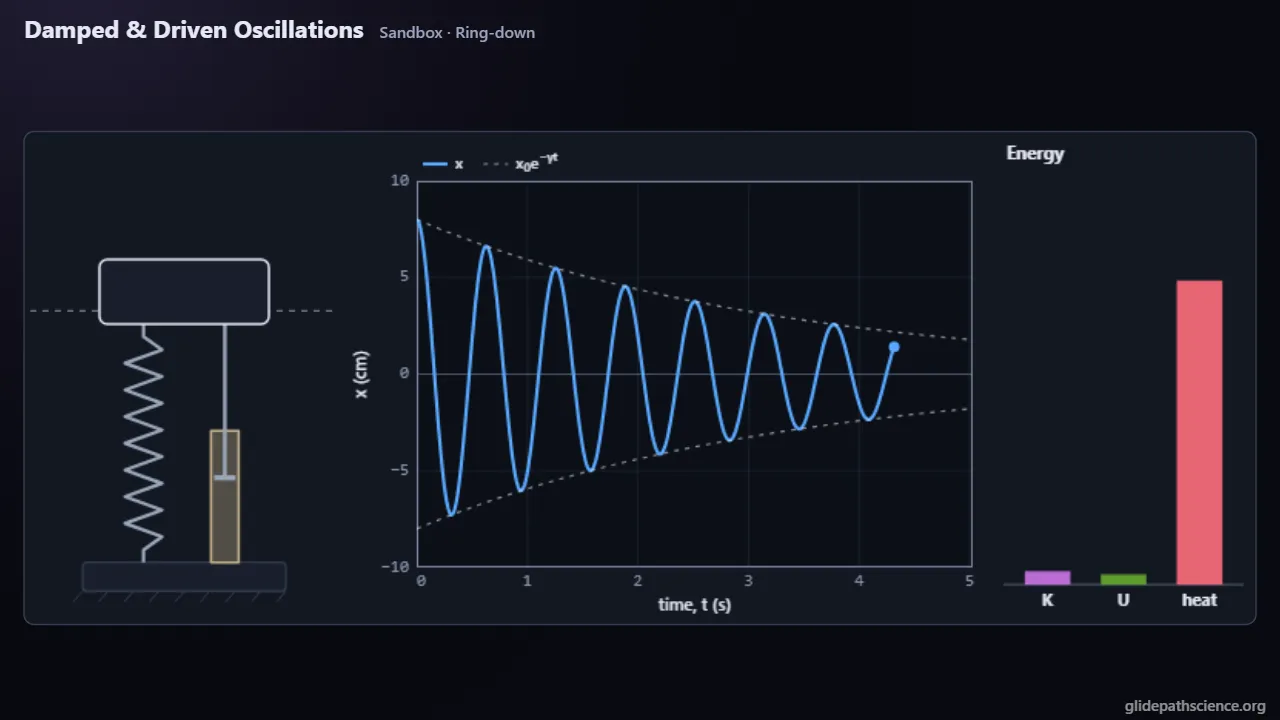
Push a car’s corner down and let it go: does it bounce, settle or creep? Students set one oscillator’s mass, spring and damping, leave it free or drive it with a force or a shaken base, change anything mid-run, and follow its energy books. A guided walkthrough at two levels runs from the damping force through the three regimes, critical damping, the energy lost per cycle, a driven block’s frequency and phase, how high resonance climbs, where the energy goes, a shaken base and designing a shock absorber; the Advanced track adds transient and steady state, the slow root, Q exactly, three resonances, ring-up, isolation, sensors, fluid drag and the RLC analogy. A Frequency Sweep measures the amplitude and phase cycle by cycle, as a lock-in amplifier would; a Phasor View draws the forces as rotating arrows; a Ride Bench drives a quarter car over a speed bump, up a curb or along a washboard road. A concept challenge with Which settles first?, and a prediction lab with Tune the mount, round it out.
What you'll learn
- Recognize the three regimes of a damper that pushes against the velocity, F = −bv: below b_c = 2√(mk) the block bounces, at b_c it returns fastest without a bounce, and above it the block creeps.
- Explain that a driven oscillator settles at the drive’s frequency, in step below resonance, a quarter cycle behind at resonance and against the drive above it, as the drive fights the spring, then the damper, then inertia.
- Explain that at resonance only the damper resists, F₀ = bv_max, so all the drive’s power becomes heat: halving the damping doubles the peak, while far from resonance damping hardly matters.
- Explain vibration isolation: when the base of a soft mount shakes faster than √2 f₀, the block moves less than the base, and there more damping lets more through.
What you can do
- Guided walkthroughStep-by-step, in Intro and Advanced tracks.
- SandboxEvery control of the model, to explore freely.
- Virtual labA realistic experiment with measurement noise and data analysis.
- Concept checksQuestions about ideas and vocabulary, with no calculating.
- PredictionCommit to a prediction, then see the result.
- Classroom demoProjector mode and recordable clips for slides.
- Works offlineA single downloadable file, verified to run without a network.
Before you start
- Simple harmonic motion: period, frequency and amplitude
- Springs, kinetic and potential energy, and Newton’s second law
- For the Advanced track: linear differential equations with constant coefficients, complex exponentials, and logarithms
Run or download
Run it in your browser
Nothing to install and no account. Works on laptops, Chromebooks, tablets, and phones.
Launch Damped & Driven OscillationsDownload for offline use
One HTML file (749 kB) that opens in any modern browser with no network: for rooms with unreliable Wi-Fi, or to keep a copy.
Download the fileFile details and checksum
- File
damped-driven-oscillations-v1.0.html- Version
- 1.0, released November 15, 2026
- Build
4851cb2- Size
- 767,453 bytes
- SHA-256
878bb36862b3cf0fc51732ec6a57458ef5209398b9b24418584a7fac4efa5147- Offline
- Checked to run with all network access blocked.
The model and its limits
What the model assumes
- Closed forms give every answer: the free response in all three regimes, the steady state, transmissibility, overshoot, the peak frequency, the energy kept per cycle and the settling time.
- The stage runs a fourth-order Runge–Kutta integration with energy books for the heat and the drive’s work, agreeing with the closed forms to a few parts in a million.
- A change mid-run carries on from where the block is, with the drive’s phase continuous.
- Fluid drag (Advanced) is integrated exactly; its amplitude law is the first-order, equivalent-linear-damping result, exact when each cycle loses only a small part of its amplitude.
- The lab block is 0.500 kg on 50.0 N/m; the car corner is a quarter car of 400 kg on 25,600 N/m with a typical 1.27 Hz ride frequency, and the damping ratios quoted for cars and seismometers are typical values.
What it leaves out
- No nonlinear springs, chaos or dry friction; Simple Harmonic Motion & Pendulums has those.
- One degree of freedom only: no coupled modes or tuned mass damper, and the quarter car has no wheel mass or tire stiffness, so no wheel hop.
- Real dampers’ details, such as different rebound and compression settings, valves and the oil heating up, are left out.
- No parametric driving, no drive other than a sine, a bump or a step, and no motion sideways.
Cite this simulation
APA 7
Meier, D. (2026). Damped & Driven Oscillations (Version 1.0) [Computer simulation]. Glidepath Science. https://glidepathscience.org/simulations/damped-driven-oscillations/
MLA 9
Meier, David. Damped & Driven Oscillations. Version 1.0, Glidepath Science, 2026, glidepathscience.org/simulations/damped-driven-oscillations/.
AIP
D. Meier, Damped & Driven Oscillations, version 1.0 (Glidepath Science, 2026), https://glidepathscience.org/simulations/damped-driven-oscillations/.
BibTeX
@misc{meier2026dampeddrivenoscillations,
  author       = {Meier, David},
  title        = {{Damped & Driven Oscillations}},
  year         = {2026},
  publisher    = {Glidepath Science},
  version      = {1.0},
  note         = {Interactive simulation, version 1.0},
  howpublished = {\url{https://glidepathscience.org/simulations/damped-driven-oscillations/}},
  url          = {https://glidepathscience.org/simulations/damped-driven-oscillations/}
}
Credits and license
Created by Dr. David Meier, Glidepath Science.
Based on: OpenStax, University Physics Volume 1, by William Moebs, Samuel J. Ling and Jeff Sanny: Chapter 15, “Oscillations,” §15.5 “Damped Oscillations” and §15.6 “Forced Oscillations,” an open textbook licensed CC BY-NC-SA 4.0 (openstax.org). The Intro track follows its order of topics and its notation; the text, numbers, figures and simulations are this lab’s own. No endorsement by OpenStax or the authors is implied.
Licensed under Creative Commons Attribution-NonCommercial-ShareAlike 4.0 International (CC BY-NC-SA 4.0). You may share and adapt it for noncommercial purposes, such as teaching, with credit and under the same license. Licensing and reuse
AI tools (Claude, from Anthropic, and ChatGPT, from OpenAI) were used in developing Glidepath Science and its simulations. Dr. David Meier reviewed, edited, and modified every release version.