
NewVersion 1.3
Sound & Resonance Tubes
Find the resonances of open and closed tubes, measure the speed of sound, and predict it from the gas: air, helium, or CO₂. Then decibels, the ear’s range, and its 3 kHz resonance, with sound you can hear.
About this simulation
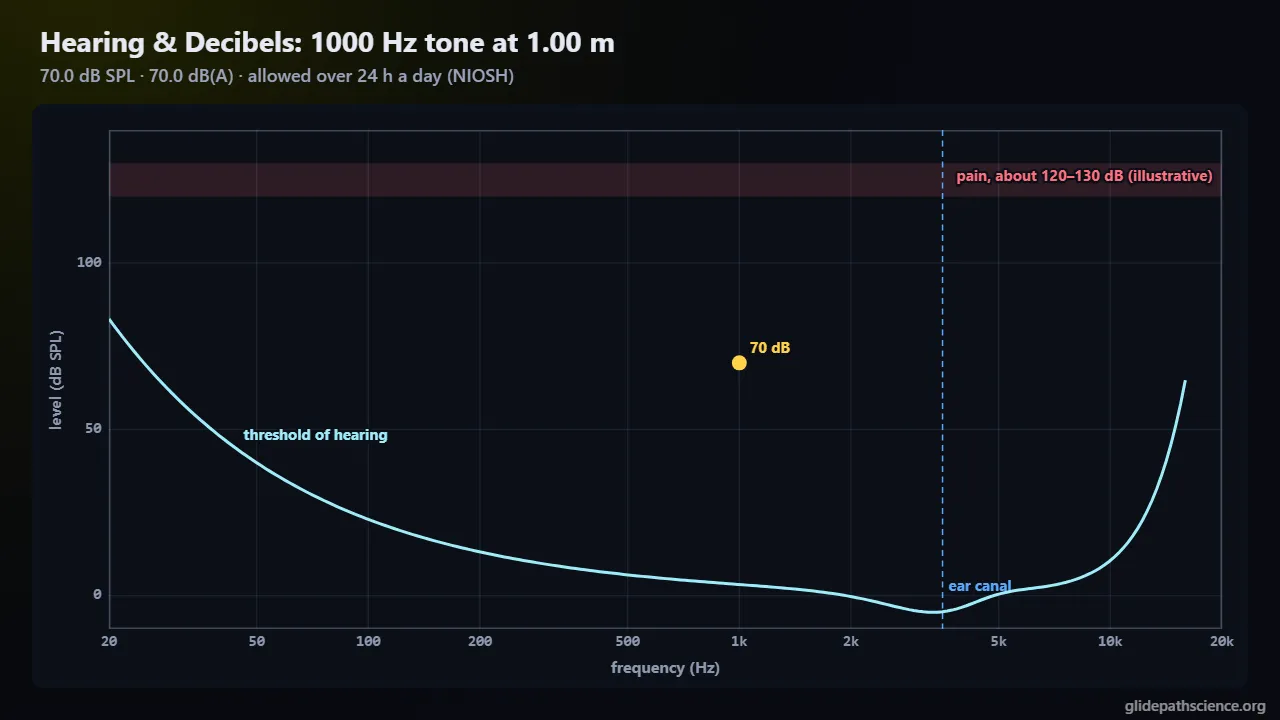
A resonance tube built on an exact one-dimensional acoustic model: the driven field of a lossy air column with end corrections (0.6133a unflanged, 0.8216a flanged), radiation from the open end, and Kirchhoff’s wall losses, so each resonance has a real width and Q. Gases are ideal mixtures whose γ follows their vibrational modes (carbon dioxide’s bend), with humid air from Buck’s saturation pressure. Students watch the air parcels and the displacement and pressure envelopes along the tube, lower the water to find resonances, measure the speed of sound from their spacing, and predict it from the gas and temperature before the reveal. A Tube Bench reproduces the real lab: nine tuning forks, a reservoir can, a meter stick read at the meniscus, a thermometer and hygrometer, and a jittery sound-level meter, with means, standard errors, and an Advanced fit for v and the end correction. Hearing & Decibels puts a sound-level meter on a distance ruler, with dB SPL and dB(A), exposure limits, the threshold of hearing, and the ear canal’s resonance. Sound is used throughout: struck forks that swell at resonance, noise through a filling bottle, pipe harmonics, the helium voice, and a hearing-range sweep with a headphone caution. An Advanced track covers Newton and Laplace, the origin of γ, humid air, p = −B ∂s/∂x, measuring δ, the losses that set Q, γ and M from a density, sound pressure level, how small a sound is, A-weighting, and formants.
What you'll learn
- Predict the speed of sound in a gas from its temperature and molar mass with v = √(γRT/M), and explain why pressure does not change it.
- Find the resonances of closed and open tubes, explain the end correction, and measure the speed of sound from the spacing of resonances.
- Locate the displacement and pressure nodes and antinodes in a standing sound wave, and relate them through p = −B ∂s/∂x.
- Use decibels for intensity and sound pressure, and relate the ear’s range and sensitivity to the threshold of hearing and the ear canal’s resonance.
What you can do
- Guided walkthroughStep-by-step, in Intro and Advanced tracks.
- SandboxEvery control of the model, to explore freely.
- Virtual labA realistic experiment with measurement noise and data analysis.
- Concept checksQuestions about ideas and vocabulary, with no calculating.
- PredictionCommit to a prediction, then see the result.
- Classroom demoProjector mode and recordable clips for slides.
- Works offlineA single downloadable file, verified to run without a network.
Before you start
- Waves: frequency, wavelength, and v = fλ
- Logarithms, for decibels
- For the Advanced track: the ideal gas law, heat capacities, and partial derivatives
Run or download
Run it in your browser
Nothing to install and no account. Works on laptops, Chromebooks, tablets, and phones.
Launch Sound & Resonance TubesDownload for offline use
One HTML file (981 kB) that opens in any modern browser with no network: for rooms with unreliable Wi-Fi, or to keep a copy.
Download the fileFile details and checksum
- File
sound-resonance-tubes-v1.3.html- Version
- 1.3, released November 15, 2026
- Build
d12e82b- Size
- 1,005,028 bytes
- SHA-256
639994ec3ed1bad1c9245b9950751b3eb8edbe9e985356cd6b9e6d14525d183f- Offline
- Checked to run with all network access blocked.
The model and its limits
What the model assumes
- Ideal-gas mixtures at low frequency; γ from translational, rotational, and harmonic vibrational heat capacities.
- Humid air from Buck’s saturation vapor pressure, without the enhancement factor.
- A one-dimensional air column solved exactly: a rigid closed end, and open ends with low-frequency end corrections and radiation (ka ≤ 0.5).
- Kirchhoff’s viscous and thermal wall losses, with handbook viscosities and Prandtl numbers mixed by mole fraction (approximate).
- What the meter hears is the source’s direct sound plus the tube’s radiated sound, with an illustrative coupling constant.
- The threshold of hearing from Terhardt’s approximation; A-weighting from IEC 61672-1; NIOSH and OSHA exposure rules.
What it leaves out
- No real-gas corrections or relaxation dispersion and absorption.
- No temperature gradients along the tube, and no mixing of a gas with room air at an open top.
- No wall vibration, fork directivity, or meniscus shape; no cross modes above ka = 1.84.
- The vocal tract is a uniform tube, and the ear is modeled only as its canal.
- Sound plays at relative levels only; Hear the range is an uncalibrated self-check, not a hearing test.
Cite this simulation
APA 7
Meier, D. (2026). Sound & Resonance Tubes (Version 1.3) [Computer simulation]. Glidepath Science. https://glidepathscience.org/simulations/sound-resonance-tubes/
MLA 9
Meier, David. Sound & Resonance Tubes. Version 1.3, Glidepath Science, 2026, glidepathscience.org/simulations/sound-resonance-tubes/.
AIP
D. Meier, Sound & Resonance Tubes, version 1.3 (Glidepath Science, 2026), https://glidepathscience.org/simulations/sound-resonance-tubes/.
BibTeX
@misc{meier2026soundresonancetubes,
  author       = {Meier, David},
  title        = {{Sound & Resonance Tubes}},
  year         = {2026},
  publisher    = {Glidepath Science},
  version      = {1.3},
  note         = {Interactive simulation, version 1.3},
  howpublished = {\url{https://glidepathscience.org/simulations/sound-resonance-tubes/}},
  url          = {https://glidepathscience.org/simulations/sound-resonance-tubes/}
}
Credits and license
Created by Dr. David Meier, Glidepath Science.
Licensed under Creative Commons Attribution-NonCommercial-ShareAlike 4.0 International (CC BY-NC-SA 4.0). You may share and adapt it for noncommercial purposes, such as teaching, with credit and under the same license. Licensing and reuse
AI tools (Claude, from Anthropic, and ChatGPT, from OpenAI) were used in developing Glidepath Science and its simulations. Dr. David Meier reviewed, edited, and modified every release version.