
NewVersion 1.3
Gravitation & Satellite Orbits
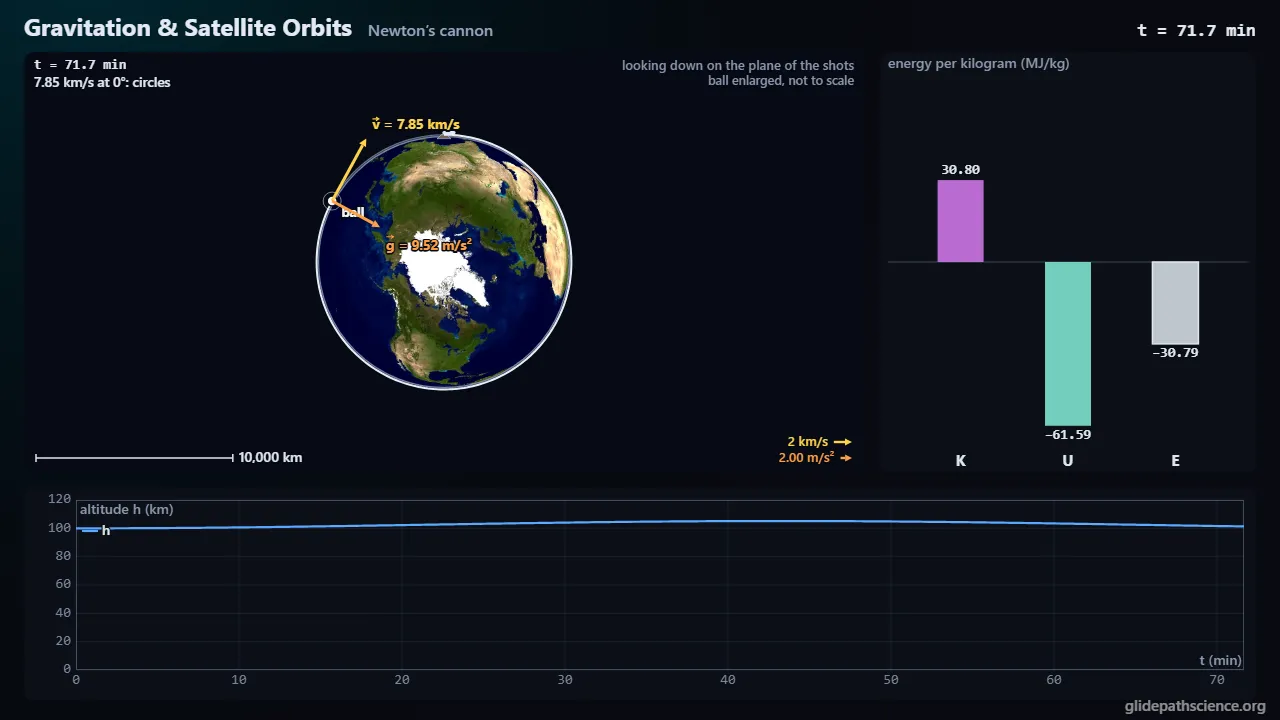
Fire Newton’s cannon faster and faster until the ball falls around the Earth: g with height and depth, orbital speed and period, geostationary orbits, escape, ellipses, Hohmann transfers, and G from a torsion balance.
About this simulation
Every flight in this lab is exact two-body motion: a chain of Kepler conics joined at instantaneous burns, with burns timed to the exact perigee or apogee and every landing and escape found on the path itself. A guided walkthrough at two levels follows OpenStax University Physics Volume 1, chapter 13: the inverse-square law with r from the center, g on the space station, escape speed in any direction, Newton’s cannon, orbits as free fall, speed and period, higher and slower, geostationary orbits and the sidereal day, the energy of an orbit, ellipses and equal areas, and the Hohmann transfer. The Advanced track goes inside the real Earth (the shell theorem and PREM) and through a gravity tunnel, then vis-viva, Kepler’s equation, Δv budgets, bi-elliptic transfers, plane changes, the Oberth effect, launch sites, phasing, the drag paradox and tides. The Sandbox fires the cannon on the Earth, the Moon, Mars or a planet of your own, starts any orbit, burns at the next perigee or apogee with a Δv ledger, decays an orbit through the air and drops a train through the planet. The Cavendish Bench is a torsion balance with a laser spot on a wall scale: read the swings, fit them for the rest points and the period, measure G with an honest uncertainty (its coverage checked by Monte Carlo, and the formula’s own bias stated for the student’s readings), and weigh the Earth. The Ground Track shows satellites over a turning Earth, from the space station to Molniya, and points a dish at a geostationary satellite. A Quick check, Which path?, Burn which way?, prediction rounds with fresh numbers, a Hohmann challenge and Weigh the planet complete it, with a printable Guide. Runs entirely offline in one file.
What you'll learn
- Use F = GMm/r² and g = GM/r² with r measured from the planet’s center, and explain why astronauts float though gravity in low orbit is nearly as strong as on the ground.
- Find orbital speed and period from v = √(GM/r) and T = 2π√(r³/GM), explain why higher orbits are slower, and find the geostationary orbit from the sidereal day.
- Use E = −GMm/2a to tell bound from unbound paths, and find escape speed, which does not depend on direction.
- Plan orbit changes: a Hohmann transfer’s two forward burns and its timing, equal areas along the ellipse, and (Advanced) Δv budgets, plane changes and the Oberth effect.
What you can do
- Guided walkthroughStep-by-step, in Intro and Advanced tracks.
- SandboxEvery control of the model, to explore freely.
- Virtual labA realistic experiment with measurement noise and data analysis.
- Concept checksQuestions about ideas and vocabulary, with no calculating.
- PredictionCommit to a prediction, then see the result.
- Classroom demoProjector mode and recordable clips for slides.
- Works offlineA single downloadable file, verified to run without a network.
Before you start
- Newton’s laws and uniform circular motion
- Kinetic and potential energy, and conservation of energy
- For the Advanced track: vectors, angular momentum and simple harmonic motion
Run or download
Run it in your browser
Nothing to install and no account. Works on laptops, Chromebooks, tablets, and phones.
Launch Gravitation & Satellite OrbitsDownload for offline use
One HTML file (1003 kB) that opens in any modern browser with no network: for rooms with unreliable Wi-Fi, or to keep a copy.
Download the fileFile details and checksum
- File
gravitation-satellite-orbits-v1.3.html- Version
- 1.3, released November 15, 2026
- Build
651a0c7- Size
- 1,027,532 bytes
- SHA-256
2faf8adbbe787753d2fde67ccb6b1730b6685776406ffdbeaf494ad656b374a5- Offline
- Checked to run with all network access blocked.
The model and its limits
What the model assumes
- Exact two-body (Kepler) motion by universal variables; the planet does not move (the Moon preset uses μ = G(M + m)).
- Instantaneous burns, timed to exact apsis times from Kepler’s equation.
- A spherical Earth of the mean radius, 6,371 km, GM = 3.986004418 × 10¹⁴ m³/s², turning once a sidereal day.
- Inside the Earth: uniform, or PREM’s layered density scaled to match GM.
- Drag against an illustrative exponential atmosphere turning with the Earth, integrated by Dormand–Prince with the energy books balanced.
- The torsion balance as a damped torsion pendulum with all four sphere pairs’ torques; seeded noise; a least-squares fit whose ± covers the noiseless record’s G in about 66 % of simulated runs (68 % for an ideal error bar), the gap being the first-order formula’s bias, which the bench states.
What it leaves out
- No Earth oblateness (J2): no nodal regression, sun-synchronous orbits or apsidal locking.
- No lunar or solar pull on satellites, no radiation pressure, no relativity.
- The atmosphere is illustrative and does not vary day to day; launches ignore gravity and drag losses.
- Burns are instantaneous; the satellite has no size, shape or attitude.
- The torsion balance is an illustrative classroom design; its beam mass, case attraction and temperature drift are left out.
Cite this simulation
APA 7
Meier, D. (2026). Gravitation & Satellite Orbits (Version 1.3) [Computer simulation]. Glidepath Science. https://glidepathscience.org/simulations/gravitation-satellite-orbits/
MLA 9
Meier, David. Gravitation & Satellite Orbits. Version 1.3, Glidepath Science, 2026, glidepathscience.org/simulations/gravitation-satellite-orbits/.
AIP
D. Meier, Gravitation & Satellite Orbits, version 1.3 (Glidepath Science, 2026), https://glidepathscience.org/simulations/gravitation-satellite-orbits/.
BibTeX
@misc{meier2026gravitationsatelliteorbits,
  author       = {Meier, David},
  title        = {{Gravitation & Satellite Orbits}},
  year         = {2026},
  publisher    = {Glidepath Science},
  version      = {1.3},
  note         = {Interactive simulation, version 1.3},
  howpublished = {\url{https://glidepathscience.org/simulations/gravitation-satellite-orbits/}},
  url          = {https://glidepathscience.org/simulations/gravitation-satellite-orbits/}
}
Credits and license
Created by Dr. David Meier, Glidepath Science.
Licensed under Creative Commons Attribution-NonCommercial-ShareAlike 4.0 International (CC BY-NC-SA 4.0). You may share and adapt it for noncommercial purposes, such as teaching, with credit and under the same license. Licensing and reuse
AI tools (Claude, from Anthropic, and ChatGPT, from OpenAI) were used in developing Glidepath Science and its simulations. Dr. David Meier reviewed, edited, and modified every release version.