
NewVersion 1.3
Kinetic Theory & Gas Laws
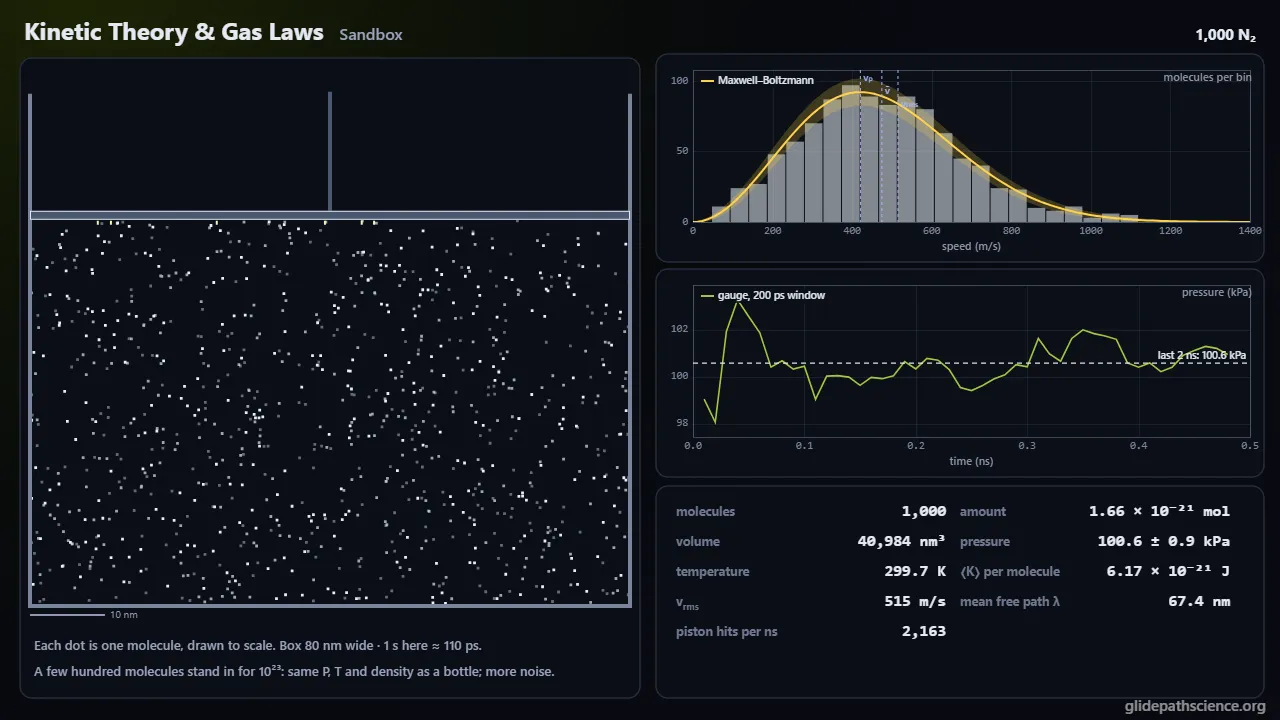
Hundreds of real molecules at true size in an 80 nm box: pressure from their hits, the Maxwell–Boltzmann spread of speeds, and Boyle’s, Charles’s, Gay-Lussac’s, and Avogadro’s laws as experiments with real data.
About this simulation
Every dot is one real molecule, with its real mass and size, moving at its real speed in a box 80 nm wide, computed by event-driven hard-sphere molecular dynamics in three dimensions. Students count the impulse the hits deliver to a piston and find atmospheric pressure, warm a sealed tank and see why only kelvins work, extrapolate a free piston’s volume to absolute zero, squeeze a gas in a bath (Boyle) or insulated (it heats, following TV^(γ−1)), and watch an all-at-one-speed start spread into the Maxwell–Boltzmann distribution. A Sandbox offers ten gases, mixtures, a held or free piston, baths, a heater plate, a pinhole and an inlet, a dust grain in Brownian motion, and, in Advanced, enlarged and attracting molecules. The Gas Law Bench runs Boyle’s, Charles’s, Gay-Lussac’s, and Avogadro’s laws at lab scale with illustrative sensor noise and a gas that lags its bath, fitted with standard errors to find absolute zero and R, beside a live sample of the gas’s molecules. The Speed Distribution counts the fast tail and, in Advanced, shows velocity components and a molecular beam through a rotating velocity selector. The Advanced track covers the momentum-flux derivation, the wall collision rate, the mean free path, equipartition and heat capacities, fluctuations, excluded volume, and attraction.
What you'll learn
- Explain gas pressure as the momentum delivered by molecular collisions with the walls, and compute it from impulse per area per time.
- Relate temperature in kelvins to the average kinetic energy of the molecules, and compute rms speeds for gases of different molar mass.
- Describe the Maxwell–Boltzmann distribution of molecular speeds, its characteristic speeds, and how its fast tail grows with temperature.
- Run Boyle’s, Charles’s, Gay-Lussac’s, and Avogadro’s laws as experiments, fit the data with uncertainties, and combine them into PV = nRT.
What you can do
- Guided walkthroughStep-by-step, in Intro and Advanced tracks.
- SandboxEvery control of the model, to explore freely.
- Virtual labA realistic experiment with measurement noise and data analysis.
- Concept checksQuestions about ideas and vocabulary, with no calculating.
- PredictionCommit to a prediction, then see the result.
- Classroom demoProjector mode and recordable clips for slides.
- Works offlineA single downloadable file, verified to run without a network.
Before you start
- Momentum and impulse; kinetic energy
- Moles, molar mass, and Avogadro’s number
- Reading graphs and fitting a straight line
- For the Advanced track: algebra with exponentials, an introduction to probability distributions, and basic calculus
Run or download
Run it in your browser
Nothing to install and no account. Works on laptops, Chromebooks, tablets, and phones.
Launch Kinetic Theory & Gas LawsDownload for offline use
One HTML file (907 kB) that opens in any modern browser with no network: for rooms with unreliable Wi-Fi, or to keep a copy.
Download the fileFile details and checksum
- File
kinetic-theory-gas-laws-v1.3.html- Version
- 1.3, released November 15, 2026
- Build
bf963cf- Size
- 928,937 bytes
- SHA-256
456683b789001634123aa43035a21e547402acc30a025913d3f28baf14f43f1d- Offline
- Checked to run with all network access blocked.
The model and its limits
What the model assumes
- Event-driven hard-sphere molecular dynamics in three dimensions, drawn as a front view; each collision, wall hit, and piston hit exact to round-off.
- Real masses (IUPAC atomic weights) and hard-sphere diameters from gas-viscosity fits; walls act on molecular centers.
- Rotations as a statistical energy reservoir shared in collisions (Borgnakke–Larsen), which keeps equipartition exact; vibrations frozen.
- Thermal walls re-emit molecules from the wall’s own Maxwellian; a free piston is an elastic mass with a gentle, booked damper.
- Attraction, where shown, is a square well around each hard core.
- The Gas Law Bench works at lab scale with an ideal gas (real nitrogen is within about 0.1 % of ideal there), an illustrative 30 s thermal lag, and illustrative instrument noise.
What it leaves out
- Hard spheres and square wells only: no soft (Lennard-Jones) potentials.
- No quantum freezing of rotations or vibrational excitation; these are described, not simulated.
- No reactions, ionization, wall adsorption, or wall heat capacity.
- Gravity, conduction, and convection are absent: at this size heat crosses the box ballistically.
- A few hundred to a few thousand molecules: intensive quantities match a bottle of gas, but their scatter is far larger, and the small box lowers the collision rate by about 2 %.
- The same seed can give different molecules in different browsers; statistics, not trajectories, are reproducible.
Cite this simulation
APA 7
Meier, D. (2026). Kinetic Theory & Gas Laws (Version 1.3) [Computer simulation]. Glidepath Science. https://glidepathscience.org/simulations/kinetic-theory-gas-laws/
MLA 9
Meier, David. Kinetic Theory & Gas Laws. Version 1.3, Glidepath Science, 2026, glidepathscience.org/simulations/kinetic-theory-gas-laws/.
AIP
D. Meier, Kinetic Theory & Gas Laws, version 1.3 (Glidepath Science, 2026), https://glidepathscience.org/simulations/kinetic-theory-gas-laws/.
BibTeX
@misc{meier2026kinetictheorygaslaws,
  author       = {Meier, David},
  title        = {{Kinetic Theory & Gas Laws}},
  year         = {2026},
  publisher    = {Glidepath Science},
  version      = {1.3},
  note         = {Interactive simulation, version 1.3},
  howpublished = {\url{https://glidepathscience.org/simulations/kinetic-theory-gas-laws/}},
  url          = {https://glidepathscience.org/simulations/kinetic-theory-gas-laws/}
}
Credits and license
Created by Dr. David Meier, Glidepath Science.
Based on: OpenStax, University Physics Volume 2, by Samuel J. Ling, Jeff Sanny and William Moebs: Chapter 2, “The Kinetic Theory of Gases” (§2.1–2.4), and §3.6, “Adiabatic Processes for an Ideal Gas,” an open textbook licensed CC BY-NC-SA 4.0 (openstax.org). The molecular picture follows its order of topics and its notation: N, k_B, n, R, v_rms, K_avg, λ, C_V, and γ. The wording, numbers, figures, and simulations are the sim’s own. No endorsement by OpenStax or the authors is implied.
Based on: OpenStax, Chemistry 2e, by Paul Flowers, Klaus Theopold, Richard Langley and William R. Robinson: Chapter 9, “Gases” (§9.1–9.6), an open textbook licensed CC BY-NC-SA 4.0 (openstax.org). The gas laws follow its order and its units (atm, torr, kPa, L, mol, and R = 0.08206 L·atm/(mol·K)). The wording, numbers, figures, and simulations are the sim’s own. No endorsement by OpenStax or the authors is implied.
Licensed under Creative Commons Attribution-NonCommercial-ShareAlike 4.0 International (CC BY-NC-SA 4.0). You may share and adapt it for noncommercial purposes, such as teaching, with credit and under the same license. Licensing and reuse
AI tools (Claude, from Anthropic, and ChatGPT, from OpenAI) were used in developing Glidepath Science and its simulations. Dr. David Meier reviewed, edited, and modified every release version.