
NewVersion 1.4
Inclined Planes & Friction
Tilt a ramp until the block lets go: static and kinetic friction, the slipping angle, pushes up and down the slope, a ramp that just holds, stick-slip and rolling, all from one exact engine.
About this simulation
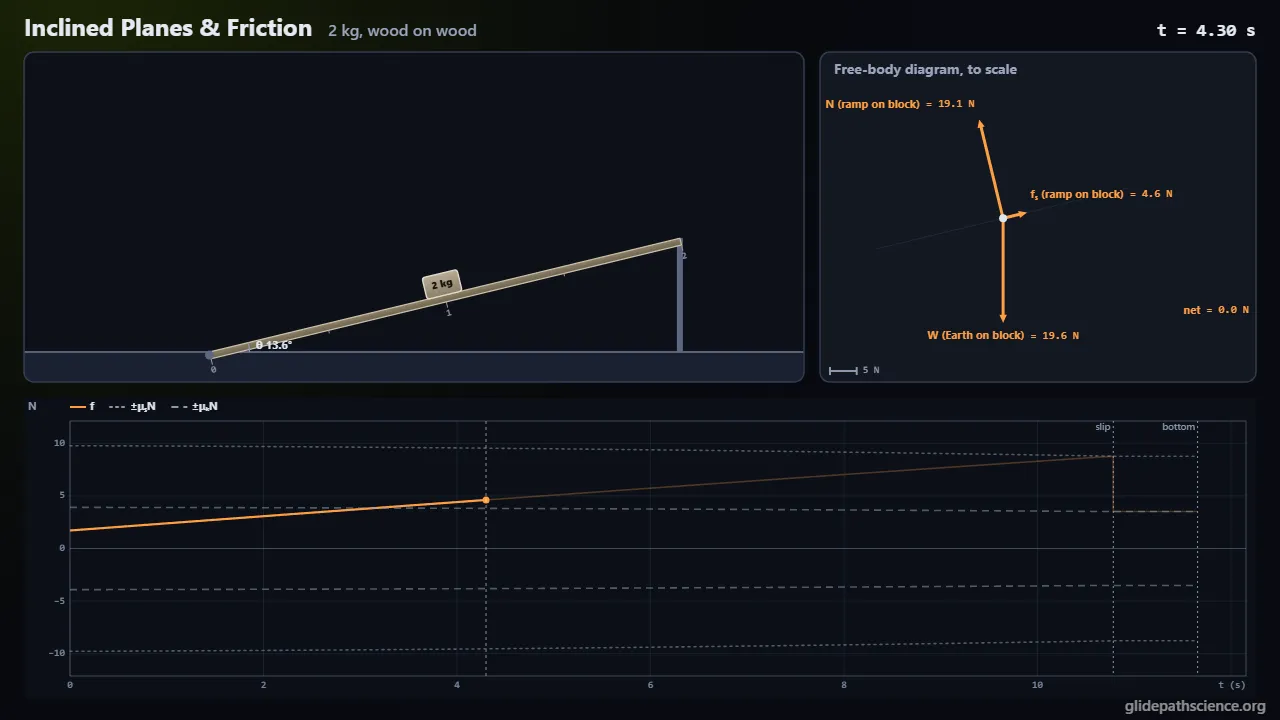
Friction pushes back only as hard as it must, until it can't. Students tilt a ramp slowly and watch static friction grow to match the pull down the slope until the block lets go at tan θ = μs, the same angle for any mass and on any planet. They push blocks up and down the slope, hold them with a push, launch them up and watch them come back slower, and see friction pick its direction on a live free-body diagram labeled by type and agent. An Intro walkthrough covers tilted axes, the normal force, the slipping angle, kinetic friction, constant-speed sliding, pushes, a launch up and back, and a ramp designed with a factor of safety; an Advanced track adds the friction cone, the angle of least effort, self-locking, the lurch at the slip, fitting measured data, spring-driven stick-slip, rolling with and without slipping, a race of a block against three rollers, and the limits of the Amontons–Coulomb model. A Tilt Lab measures μs over repeated trials and μk from timed slides with a stopwatch or photogates, and a Regime Map shows where a pushed block holds, slides down or slides up. Every answer comes from an exact, event-driven engine with no step size.
What you'll learn
- Find the friction force on a body at rest on a ramp, recognizing that static friction matches whatever would make it slip, up to μsN, and choosing its direction from the slipping it prevents.
- Use tilted axes, N = mg cos θ and tan θ = μs to predict when a block slips, and explain why the slipping angle is independent of mass and gravity.
- Apply ΣF = ma along the slope with kinetic friction to blocks sliding up or down, pushed or launched, including the band of pushes that hold a block and the push for constant speed.
- Analyze advanced cases: the friction cone, the best pulling angle, self-locking, stick-slip on a spring drive, and the acceleration and grip needed for rolling without slipping.
What you can do
- Guided walkthroughStep-by-step, in Intro and Advanced tracks.
- SandboxEvery control of the model, to explore freely.
- Virtual labA realistic experiment with measurement noise and data analysis.
- Concept checksQuestions about ideas and vocabulary, with no calculating.
- PredictionCommit to a prediction, then see the result.
- Classroom demoProjector mode and recordable clips for slides.
- Works offlineA single downloadable file, verified to run without a network.
Before you start
- Newton's second law and free-body diagrams
- Vectors and their components
- Right-triangle trigonometry
- Constant-acceleration kinematics
Run or download
Run it in your browser
Nothing to install and no account. Works on laptops, Chromebooks, tablets, and phones.
Launch Inclined Planes & FrictionDownload for offline use
One HTML file (828 kB) that opens in any modern browser with no network: for rooms with unreliable Wi-Fi, or to keep a copy.
Download the fileFile details and checksum
- File
inclined-planes-friction-v1.4.html- Version
- 1.4, released November 15, 2026
- Build
bb9b440- Size
- 847,514 bytes
- SHA-256
b9496d3ca1dbdb84135571eb75dd1581e3b7d264ca713bb5def66bb893942e49- Offline
- Checked to run with all network access blocked.
The model and its limits
What the model assumes
- Amontons–Coulomb friction with coefficients from the library's shared surface table: static friction up to μsN, kinetic friction μkN independent of speed, and an instant drop at the slip.
- The body is a point on the ramp's flat surface; blocks slide and never tip; rollers are a uniform solid sphere, solid cylinder or hoop.
- Motion between events is exact and in closed form (constant acceleration, or simple harmonic motion on the spring drive); events such as the slip, a stop, the end of a tilt and the end of the ramp are found exactly and never stepped across.
- A slow tilt turns the ramp at a steady rate while the block is at rest and stops at the slip; its rotating-frame effects are neglected.
- The spring obeys Hooke's law and its far end moves at constant speed; pushes are constant in size and direction.
- Runs end for a physical reason: the body comes to rest for good, reaches an end of the ramp, lifts off, or the spring's puller reaches the top.
What it leaves out
- Friction does not depend on speed, contact time, temperature or apparent area, so real stick-slip that smooths out at higher speeds is not reproduced.
- No tipping, rolling resistance, air drag, ramp flex or motion beyond the ends of the ramp.
- Friction coefficients are approximate values typical of introductory physics tables; the rubber-on-wet-concrete and road-surface values, the 5 % trial-to-trial scatter in μs and the 0.1 s stopwatch reaction scatter are illustrative.
- A ramp free to slide, strings between blocks, and the energy accounting of friction across systems are covered by other simulations in the library.
Cite this simulation
APA 7
Meier, D. (2026). Inclined Planes & Friction (Version 1.4) [Computer simulation]. Glidepath Science. https://glidepathscience.org/simulations/inclined-planes-friction/
MLA 9
Meier, David. Inclined Planes & Friction. Version 1.4, Glidepath Science, 2026, glidepathscience.org/simulations/inclined-planes-friction/.
AIP
D. Meier, Inclined Planes & Friction, version 1.4 (Glidepath Science, 2026), https://glidepathscience.org/simulations/inclined-planes-friction/.
BibTeX
@misc{meier2026inclinedplanesfriction,
  author       = {Meier, David},
  title        = {{Inclined Planes & Friction}},
  year         = {2026},
  publisher    = {Glidepath Science},
  version      = {1.4},
  note         = {Interactive simulation, version 1.4},
  howpublished = {\url{https://glidepathscience.org/simulations/inclined-planes-friction/}},
  url          = {https://glidepathscience.org/simulations/inclined-planes-friction/}
}
Credits and license
Created by Dr. David Meier, Glidepath Science.
Licensed under Creative Commons Attribution-NonCommercial-ShareAlike 4.0 International (CC BY-NC-SA 4.0). You may share and adapt it for noncommercial purposes, such as teaching, with credit and under the same license. Licensing and reuse
AI tools (Claude, from Anthropic, and ChatGPT, from OpenAI) were used in developing Glidepath Science and its simulations. Dr. David Meier reviewed, edited, and modified every release version.